
Best Time to Take Shilajit: Morning vs Night Guide

Table of Contents
- Why Timing Changes How Shilajit Works
- Morning vs Evening: Energy, Focus, or Sleep
- How to Consume Shilajit Resin for Best Results
- Shilajit Dosage for Beginners: Starting Slow
- Post-Workout Recovery Timing for Athletes
- What to Avoid When Taking Shilajit
- Choosing a Shilajit You Can Trust
- Frequently Asked Questions
Last Updated: September 13, 2026
Why Timing Changes How Shilajit Works
The best time to take shilajit depends on your goal: morning for energy and focus, evening for recovery and mineral replenishment. Timing matters because shilajit is not a stimulant, it supports mitochondrial function and ATP production, feeding your cells rather than pushing them.
At Stoneblood Shilajit, we hear one question constantly: does timing actually matter? Yes, but not for the reasons most guides suggest. The real answer involves absorption, circadian rhythm, and what your body is already doing at that hour.
Shilajit is a mineral-rich resin formed from compressed plant material and humus over millions of years, traditionally used in Ayurvedic medicine as a Rasayana for longevity and vitality (peer-reviewed research). Its primary active component, fulvic acid, transports minerals across cell membranes; without it, minerals pass through your digestive tract largely unused (PubMed).
Absorption Rate and the Therapeutic Window
Fulvic acid and humic acid work together to improve nutrient uptake at the cellular level. On an empty stomach, absorption is faster because less competing material is in your digestive tract, creating a narrower but more intense therapeutic window.
With food, absorption slows: the window widens but the peak effect drops. Neither approach is wrong, it depends on whether you want a sharp energy rise or a gradual release.
Morning vs Evening: Energy, Focus, or Sleep
Morning is the better choice for most people. Shilajit supports natural energy and vitality without caffeine's crash, and taking it early aligns with your natural cortisol curve, delivering mineral support when your metabolic rate is climbing and your cells demand fuel.
Evening use suits a different goal. If you take shilajit for recovery, hormonal balance, or mineral replenishment rather than alertness, a late-afternoon or early-evening dose lets the adaptogenic properties work while you rest.
Circadian Rhythm Alignment
Your body runs on a 24-hour cycle governing hormone release, body temperature, and cell repair (nigms.nih.gov). Most guides ignore this, but it is the single biggest factor in choosing your timing.
- Morning (6-10 a.m.): Best for energy, cognitive performance, and focus. Your cortisol naturally peaks here, and shilajit supports that rise rather than fighting it.
- Midday (12-2 p.m.): Useful for sustaining focus through the afternoon slump without adding caffeine.
- Late afternoon (4-6 p.m.): Ideal for athletes and martial artists training in the evening. Supports endurance and fatigue reduction during the session.
- Evening (after 8 p.m.): For recovery and hormonal support only. If you are sensitive to supplements that increase alertness, avoid this window.
How to Consume Shilajit Resin for Best Results
Resin is the traditional form. How you consume it, steps, dose, and especially the carrier, determines how much fulvic acid and trace minerals actually reach your cells.
Here is the basic protocol:
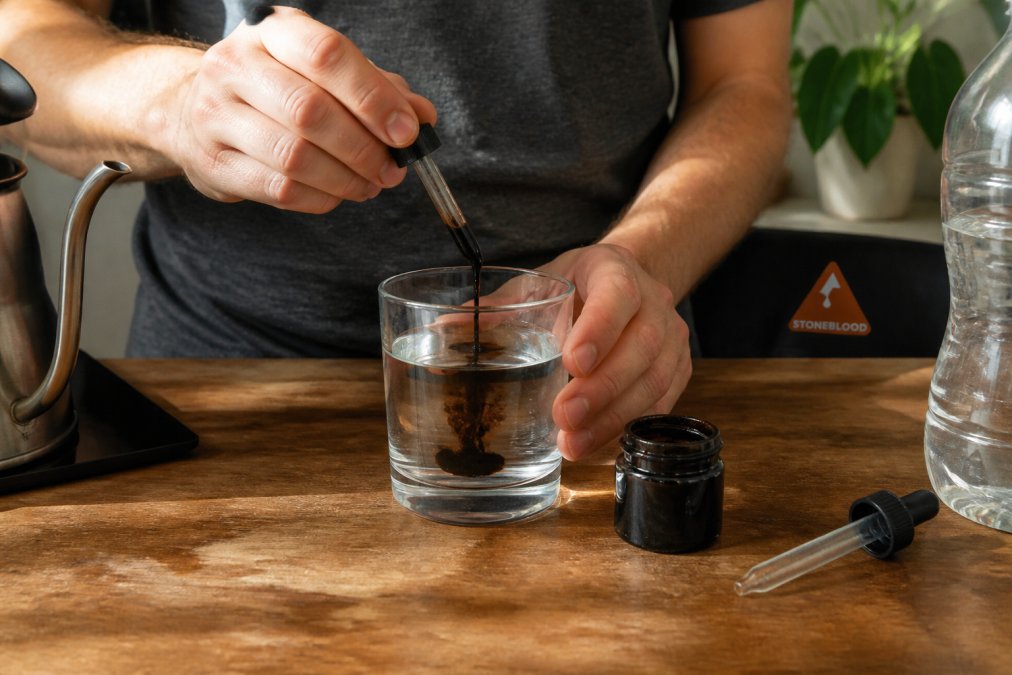
- Measure 1 dropper full, roughly 10-15 drops, of resin.
- Stir it into a glass of lukewarm water, warm milk, coffee, or tea. Warm, not boiling.
- Drink it on an empty stomach if you want faster absorption.
- Take it with food if you prefer a slower, gentler release.
- Hold it under your tongue for 30 seconds if you use it sublingually.
Carrier Substance Optimization: The Anupana Principle
Most guides tell you to mix shilajit into water and leave it at that. That ignores a concept Ayurvedic practitioners have used for centuries: Anupana, the carrier substance that determines how a remedy is absorbed, where it is delivered, and how strongly it acts.
In classical practice, the same herb taken with different Anupana produces different effects, and shilajit is no exception. The carrier changes absorption speed, mineral uptake, and even the energetic quality of the dose, the single biggest gap in Western guides, which treat the carrier as an afterthought.
| Carrier | Absorption Speed | Best For | Notes |
|---|---|---|---|
| Lukewarm water | Fast | Morning energy, empty stomach | Neutral taste, quickest uptake, traditional baseline Anupana |
| Warm milk | Moderate | Evening recovery, sleep support, hormonal balance | Fat content may aid mineral uptake; classic Anupana for Rasayana use |
| Raw honey (small amount) | Moderate | Energy and vitality goals | Traditional pairing; honey itself carries trace minerals |
| Sublingual | Fastest | Experienced users, strong taste tolerance | Bypasses digestion entirely; some report a warming sensation |
| Coffee or tea | Moderate | Habit stacking, morning routine | Heat should not be boiling; caffeine may compound the energizing effect |
Why Warm Milk Is the Traditional Evening Carrier
Warm milk is the classic Anupana for shilajit when the goal is restorative rather than stimulating. Its fat content gives the resin's fat-soluble fractions something to bind to, and the warmth helps it disperse evenly instead of clumping. Practitioners paired shilajit with warm milk in the evening for exactly this reason: it supports the slow, cumulative Rasayana effect rather than a sharp morning lift.
For hormonal balance, mineral replenishment, or recovery, warm milk in the late afternoon or early evening is the carrier most aligned with that goal. For morning energy and focus, lukewarm water is cleaner because it adds no digestive load first thing.
Temperature and Timing Rules That Actually Matter
Warm, not hot. Boiling water can degrade delicate compounds in raw resin; lukewarm water or warm milk keeps fulvic acid intact and helps the resin disperse. Simple test: if you can hold the glass comfortably against your wrist, the temperature is right.
Sublingual Use: When to Skip the Carrier Entirely
Holding resin under the tongue for 30 to 60 seconds lets some fulvic acid absorb directly through mucous membranes, bypassing first-pass digestion. It is the fastest route, preferred by experienced users wanting an immediate effect before a workout or demanding morning. The trade-offs: raw resin tastes bitter, earthy, and resinous, and you still swallow the remainder, so digestion is only partially bypassed. Sublingual is a technique, not a different product, the same dose applies.
Shilajit Dosage for Beginners: Starting Slow
Beginners should start small and build up: a quarter of a standard serving for the first three to five days, then increase gradually. Shilajit dosage for beginners is less about hitting a target number and more about finding the smallest amount that produces a noticeable effect.
Your body needs time to adjust to the mineral load. Starting too high can cause digestive discomfort, headaches, or overstimulation, none dangerous, all avoidable.
Dosage Titration and Consistency
Dosage titration means adjusting your intake in small increments based on how you respond. A practical schedule looks like this:
- Days 1-3: Quarter dose, morning only
- Days 4-7: Half dose, morning only
- Week 2: Full dose, morning only
- Week 3 onward: Full dose, morning or split morning and afternoon
Consistency matters more than any single dose. Shilajit builds in your system, so sporadic use gives sporadic results. Those who report the strongest benefits take it daily for weeks, not a large dose once, expecting a transformation.
Post-Workout Recovery Timing for Athletes
For athletes and martial artists, the best time to take shilajit depends on whether you are chasing performance during the session or recovery after it. Most guides collapse these into one vague recommendation. They are two different protocols.
Pre-Workout: 60 to 90 Minutes Before Training
A pre-training dose supports endurance and fatigue resistance during the session. Take it 60 to 90 minutes before training, mixed into lukewarm water on a relatively empty stomach, so absorption peaks as you warm up, giving fulvic acid time to shuttle minerals into cells before sweat depletes them.
This suits endurance athletes, fighters, and anyone training longer than 45 minutes. It is weaker for short, high-intensity strength sessions, where the pre-workout window overlaps with a meal and slows absorption.
Post-Workout: The 30-to-60-Minute Recovery Window
Exercise depletes minerals through sweat and increases oxidative stress. Shilajit's minerals and fulvic acid support recovery by replenishing what you lost and helping cells repair. Take it within 30 to 60 minutes after training, in water or a post-workout drink, to catch the window when your body is most receptive to mineral repletion.
Many athletes split the dose on training days: a smaller pre-workout serving for performance and a smaller post-workout serving for recovery, rather than one large dose at either end. This keeps daily intake steady while matching timing to the goal.
Matching Timing to Training Type
| Training Type | Best Timing | Why |
|---|---|---|
| Endurance (running, cycling, long sessions) | 60-90 min pre-workout | Supports sustained energy and fatigue resistance through the session |
| Strength and power | Post-workout, 30-60 min after | Recovery and mineral repletion matter more than intra-session energy |
| Martial arts and evening training | Small post-workout dose only | A full dose late at night can interfere with sleep for sensitive users |
| Rest days | Morning dose only | Maintains consistency without stacking on training-day timing |
The Evening-Training Caveat
If you train in the evening, keep your post-workout dose small. A full dose late at night can interfere with sleep for those sensitive to its energizing effects. Recovery does not require a large dose, a half serving in warm water supports mineral repletion without pushing alertness past bedtime.
What to Avoid When Taking Shilajit
Knowing what to avoid when taking shilajit matters as much as knowing when to take it. Common mistakes that undermine results:
- Taking it with high-dose vitamin C or acidic drinks. Very acidic environments can alter how fulvic acid behaves. Keep it simple with water or milk.
- Doubling up when you miss a dose. Skip it and resume your normal schedule. More is not better here.
- Taking it on a completely empty stomach if you are sensitive. Some people get mild nausea. A small snack solves it.
- Buying resin that has not been tested. Heavy metal testing is not optional. Untested shilajit can carry contaminants.
- Expecting overnight results. Shilajit works cumulatively. Give it at least two to three weeks.
Choosing a Shilajit You Can Trust
Quality determines whether timing even matters. A poorly sourced resin with fillers will not deliver the same results no matter when you take it.
Stoneblood Shilajit is wildcrafted in the Rocky Mountains of Utah and refined in distilled spring water. Every batch is bottled in a cGMP-certified facility and third-party tested for heavy metals and microbials. Each bottle is lot-coded and traceable.
Our Shilajit Original is the starting point for most people at $33.00. If you want a more concentrated daily serving, Magic Brown Double Strength runs $63.00. And if you already know this belongs in your routine, the 3-bottle pack at $87.00 brings the per-bottle cost down.


What most buyers miss: sourcing transparency matters more than marketing claims. A brand that names its lab and shares its results is one you can actually evaluate.
The challenge with shilajit is not finding it. It is finding a version pure enough that timing, dosage, and carrier substance actually matter. Stoneblood Shilajit is hand-harvested by one person in the Rocky Mountains, refined in distilled spring water, and bottled in a cGMP-certified facility with third-party testing on every batch. Start with the morning dose, stay consistent, and give it three weeks. Get started with Stoneblood Shilajit and build a routine that supports your energy, focus, and recovery from the ground up.
Frequently Asked Questions
What is the best time of day to take shilajit?
Most people do well taking shilajit in the morning on an empty stomach, roughly 20 to 30 minutes before breakfast. This timing supports steady energy and focus through the day. If you train hard, a second smaller dose after your workout can help with recovery. Evening use suits some people for relaxation, but if it keeps you alert, keep your dose before 2 p.m. and stay consistent with whichever window you choose.
Can I take shilajit on an empty stomach?
Yes, and many users prefer it. An empty stomach may support faster absorption of fulvic acid and minerals before food competes for uptake. If you feel mild stomach discomfort, take it with a small amount of warm water or a light snack. Start with a low dose, see how your body responds, and adjust from there. Consistency matters more than perfect timing.
What should I avoid when taking shilajit?
Avoid taking shilajit with caffeine-heavy drinks if you are sensitive, since both can be stimulating. Skip iron supplements within two hours of your dose because minerals can compete for absorption. Do not combine shilajit with blood thinners or prescription medication without checking with your doctor first. Also avoid unverified brands, since heavy metal contamination is a real concern with low-quality resin.
How long does it take for shilajit to start working?
Some people notice sharper focus or steadier energy within the first few days, especially when they take it in the morning on an empty stomach. Fuller effects on endurance, recovery, and overall vitality usually build over two to four weeks of daily use. Shilajit is not a stimulant, so do not expect an instant jolt. Track your energy and sleep for a month before judging results.