
Pure Shilajit Resin vs Powder Supplements: Which Wins?

Table of Contents
- What Is Shilajit Resin and Why Form Matters
- Pure Shilajit Resin vs Powder Supplements: Side-by-Side Comparison
- How to Use Shilajit Resin: A Practical Daily Routine
- Shilajit Dosage Guidelines for Resin and Powder
- How to Spot Authentic Resin and Avoid Adulterated Powder
- Stoneblood Shilajit: A Resin Built for Purity and Traceability
- Frequently Asked Questions
Last Updated: September 25, 2026
What Is Shilajit Resin and Why Form Matters
Shilajit resin is a thick, tar-like substance that seeps from rock formations in high mountain ranges, formed over millions of years from compressed plant material and humus. This guide from Stoneblood Shilajit explains why the form you choose changes how much your body actually absorbs.
The distinction matters more than most buyers realize. Resin is the raw state of shilajit, while powders and capsules are processed versions that may include fillers or standardized extracts. According to the National Center for Complementary and Integrative Health overview of dietary supplements, how a supplement is processed affects how the body uses it. That principle applies directly here.
Resin, Powder, and Capsules: How They Differ
Shilajit resin is the unprocessed, tar-like material collected from mountain rock, often called mineral pitch in traditional texts. It contains fulvic acid, humic acid, and over 85 trace minerals in ionic form.
Powder supplements are typically made by drying resin and grinding it, sometimes adding anti-caking agents. Capsules wrap powder in a shell for convenience. Neither is inherently bad, but each step away from the raw state introduces room for additives or lower potency.
Pure Shilajit Resin vs Powder Supplements: Side-by-Side Comparison
Pure shilajit resin offers high bioavailability and purity, while powder and capsules offer convenience. Which suits you depends on how much you value absorption versus ease of use.
Here is how the three forms stack up:
| Factor | Resin | Powder | Capsules |
|---|---|---|---|
| Bioavailability | High (sublingual option) | Moderate | Moderate |
| Additives risk | Low | Higher | Higher |
| Taste | Strong, earthy, bitter | Milder | None |
| Cost-per-serving | Varies by brand | Often lower upfront | Often lowest upfront |
| Best for | Purists, biohackers | Budget buyers | Travelers |
Bioavailability: Why Resin Absorbs Better
Resin can be taken sublingually, under the tongue, where it enters the bloodstream without passing through the full digestive process. Fulvic acid in its natural resin state also helps transport minerals into cells.
Powder must be mixed into liquid and swallowed, which sends it through digestion first. A common mistake is assuming all shilajit is equal once it hits your stomach. It is not.
Fulvic acid is a humic substance dense in carboxyl and hydroxyl groups, which chelate, bind, to positively charged mineral ions and keep them soluble in the stomach's acidic environment. When that complex reaches the small intestine, the fulvic acid acts as a carrier that ferries minerals across the intestinal wall, which is why it is often described as a transporter rather than a nutrient itself.
Sublingual absorption bypasses that route. The tissue under the tongue is thin and heavily vascularized, so a portion of the fulvic-mineral complex diffuses directly into the bloodstream and skips first-pass liver metabolism.
Powder loses that option. Once mixed into water and swallowed, the only absorption pathway is gastrointestinal. That is not a flaw, but it means powder depends entirely on digestive efficiency, which varies with stomach contents, gut health, and whether the powder was cut with anti-caking agents like silicon dioxide or magnesium stearate.
Cost-per-Serving: Resin vs Powder vs Capsules
Powder often looks cheaper at first glance, but the math shifts when you factor in potency and how long a bottle lasts. A resin bottle taken at one dropper daily stretches across weeks.
For a fair comparison, divide the bottle price by the number of servings it delivers, not the grams on the label.
Here is the framework, using round numbers. A resin jar costs $50 with one dropper daily and roughly 60 droppers per jar, about $0.83 per serving. A powder tub costs $30 with one scoop daily and 30 scoops per tub, $1.00 per serving.
Storage and Shelf-Life: Keeping Resin Potent
Resin stays potent longest in a cool, dark place with the lid sealed tight. Powder is more moisture-sensitive and clumps quickly in humid air.
Shilajit Double Strength — Stoneblood →
How to Use Shilajit Resin: A Practical Daily Routine
Using shilajit resin takes about 30 seconds once you build the habit: one dropper full mixed into water, coffee, or tea each morning, or taken sublingually as you get used to the taste.
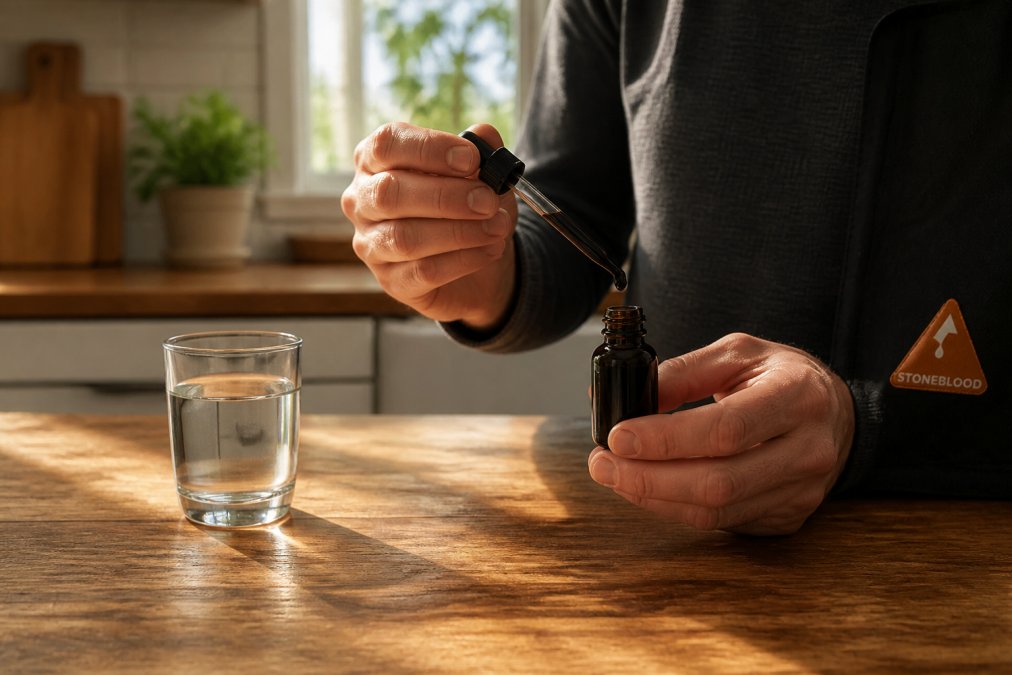
A simple routine looks like this:
- Wake up and take one dropper of resin before breakfast
- Mix it into warm water, coffee, or tea if the taste is strong
- Alternatively, hold it sublingually for a minute, then swallow
- Stay consistent for at least two to three weeks before judging results
Shilajit Dosage Guidelines for Resin and Powder
Shilajit dosage guidelines vary by form, but a common starting point is one dropper of resin daily, roughly 10 to 15 drops, or a small scoop of powder. Beginners should start low and adjust based on how they feel.
A practical way to think about dosage:
- Start with the lowest recommended serving for one week
- Increase gradually if you feel no difference
- Take it in the morning for energy, or split doses if you prefer
- Stop and consult a healthcare provider if anything feels off
How to Spot Authentic Resin and Avoid Adulterated Powder
Authentic shilajit resin has a strong, bitter, earthy aroma and a tar-like texture that softens when warmed. Adulterated powder often smells faint or sweet, a red flag.
The Water Test: A DIY Purity Check
Most articles tell you to look for lab results and stop there, leaving no way to check a product you already bought. The water test is a simple home method and works on both resin and powder.
- Authentic resin sinks, then slowly dissolves into a cloudy, amber-to-dark-brown solution. Some fine sediment may settle at the bottom; that is mineral matter, not filler. The water should smell earthy and slightly bitter.
- Adulterated resin often dissolves almost instantly into a clear or uniformly dark liquid with no sediment, or it floats and refuses to dissolve at all. Instant, clean dissolution is a sign of added sugars, gums, or soluble fillers.
- Powder behaves differently. A pure powder will cloud the water and leave a fine suspension. A cut powder may dissolve completely clear, or it may leave a chalky white residue that settles fast, a common signature of calcium carbonate or similar bulking agents.
The Heat Test and the Texture Test
Resin softens when warmed and hardens when chilled. Hold a small piece in your palm for a minute; authentic resin becomes pliable and slightly tacky. Real resin also leaves a faint stain on paper that dries to a brownish film.
Reading a Certificate of Analysis Without Being Fooled
A Certificate of Analysis, or CoA, is only as good as the lab behind it and the batch it covers.
- Is it batch-specific? A CoA that lists a lot number matching the jar in your hand is meaningful. A generic PDF with no lot number is marketing.
- Is the lab accredited? Look for ISO/IEC 17025 accreditation, which is the international standard for testing and calibration laboratories. An accredited lab's results carry more weight than an in-house report.
- What was tested? Heavy metals, arsenic, lead, cadmium, mercury, are the minimum. Microbial testing and a fulvic acid percentage are the next tier. A CoA that reports only 'purity' with no method is not useful.
Stoneblood Shilajit: A Resin Built for Purity and Traceability
Stoneblood Shilajit is wildcrafted North American resin, hand-harvested in the Rocky Mountains and refined in distilled spring water.
What sets it apart:
- Wildcrafted in Utah, not imported from offshore suppliers
- 100% pure resin with no additives, fillers, or flow agents
- Bottled in a cGMP-certified facility with lot-coded traceability
- Water-soluble, so it mixes cleanly into any drink
Frequently Asked Questions
What is better, shilajit resin or powder?
Resin retains its natural, tar-like consistency and fulvic acid content without the processing steps that powders undergo. Powder supplements are often spray-dried or mixed with fillers. Resin also lets you verify authenticity by texture, taste, and solubility. That said, powder is more convenient for travel and mixing into drinks. If potency and purity are your priorities, resin is a strong choice; if convenience matters most, powder has a place.
Which form of shilajit is most effective?
Pure shilajit resin is minimally processed and retains the full spectrum of fulvic acid, humic acid, and trace minerals in their natural ionic form. Powder and capsule forms can still work, but their effectiveness depends heavily on sourcing and whether they contain additives. Always check for third-party testing and a certificate of analysis before buying any form.
How can you tell if shilajit resin is authentic?
Authentic shilajit resin has a thick, tar-like texture that softens when warmed between your fingers. It dissolves completely in warm water, leaving no gritty residue. The taste is bitter and earthy, not sweet. Look for lot numbers, third-party test results, and a supplier who can provide a certificate of analysis for your specific batch. Stoneblood Shilajit provides lot-coded bottles and shares test results on request.
What should you not mix shilajit with?
Avoid mixing shilajit with chlorinated tap water. Also skip sugary drinks or heavily processed juices, which add unnecessary ingredients. Warm water, coffee, tea, or milk are better choices. Some people prefer taking it sublingually. If you take prescription medications, talk to your doctor before adding shilajit to your routine, since it can affect how some drugs are metabolized.
Is shilajit resin more effective than capsules?
Resin is closer to its natural state and does not require the binders, fillers, or drying processes used to make capsules. Capsules are convenient, but their efficacy depends on the quality of the powder inside and whether it has been standardized or diluted. With resin, you can see and taste the product, which makes it easier to judge authenticity. For athletes and professionals seeking sustained energy and focus, resin is a strong option.