
Shilajit vs Ashwagandha for Mental Clarity: 2026 Guide

Table of Contents
- Shilajit vs Ashwagandha for Mental Clarity: The Core Difference
- Shilajit Benefits for Brain: Focus, Memory, and Neuroprotection
- How Ashwagandha Affects Mental Clarity and Stress
- How to Take Shilajit Resin for Best Results
- Best Time of Day to Take Ashwagandha for Focus
- Stacking Shilajit and Ashwagandha: Protocols and Safety
- Which One Should You Choose for Mental Clarity?
- Frequently Asked Questions
Last Updated: September 25, 2026
Shilajit vs Ashwagandha for Mental Clarity: The Core Difference
Shilajit vs ashwagandha for mental clarity comes down to one distinction: shilajit feeds your cells the raw minerals they need to make energy, while ashwagandha calms the stress response that drains focus. One is a mineral supplement, the other an adaptogen. This guide from Stoneblood Shilajit breaks down which one fits your brain fog, and when stacking both makes sense.
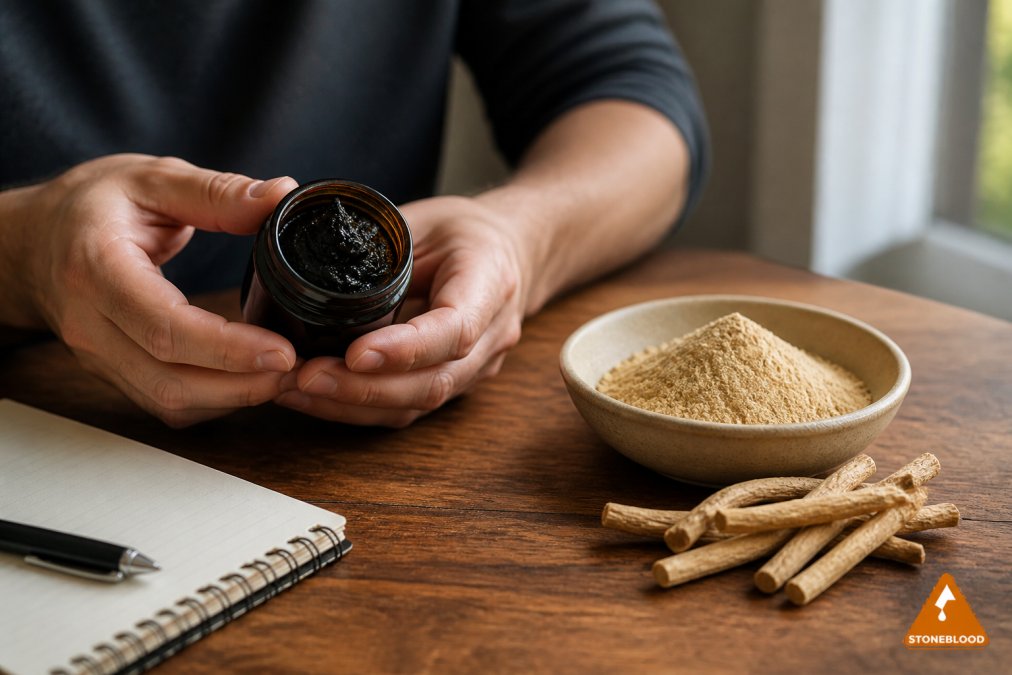
Most guides treat these as interchangeable "focus supplements," but they work on completely different systems, and the form you buy changes how much of the active compound your body absorbs.
Shilajit: Mineral-Driven Cellular Energy
Shilajit is a tar-like resin that seeps from rock layers in high mountain ranges, formed over centuries from compressed plant matter and minerals. It is rich in fulvic acid and trace minerals.
The mental clarity connection runs through your mitochondria. Your brain consumes roughly 20% of your body's resting energy despite being about 2% of your body weight, and that energy comes from ATP production. Fulvic acid and shilajit's minerals support the electron transport chain that drives that process, and fulvic acid shuttles minerals across cell membranes, which is why shilajit's minerals are more usable than the same minerals taken in isolation.
Delivery form matters more than most guides admit. Shilajit is sold as resin, powder, capsule, and liquid drops, and absorption varies widely:
- Resin, the traditional form. Dissolved in warm water, it delivers fulvic acid and minerals closest to how they occur in nature, with the fastest onset, often within 30-60 minutes.
- Capsules, convenient, but the powder is often cut with fillers and the shell delays breakdown. Onset is slower and less predictable.
- Powder, variable purity; some products are diluted with maltodextrin or other carriers, so you may get far less fulvic acid per gram than the label implies.
- Liquid drops, fast absorption but frequently low concentration, so you may need multiple droppers to match a single resin dose.
For immediate mental clarity, resin dissolved in warm water is often preferred.
Ashwagandha: Adaptogenic Stress Modulation
Ashwagandha is a root used in Ayurvedic medicine for thousands of years, classified as an adaptogen. Its active compounds, withanolides, help regulate the body's stress response.
- Standardized extract, concentrated to a set withanolide percentage, so the dose is consistent from batch to batch. This is the form most clinical research uses.
- Root powder, closer to traditional use, but withanolide content varies by harvest, so effects are less predictable.
- Tea, pleasant and gentle, but water extraction pulls only a fraction of the withanolides, making it the weakest option for a measurable effect.
Shilajit Benefits for Brain: Focus, Memory, and Neuroprotection
Shilajit benefits for brain function center on three areas: cellular energy, antioxidant protection, and mineral support for neurotransmitter activity.
How Ashwagandha Affects Mental Clarity and Stress
Ashwagandha affects mental clarity indirectly, by lowering the stress load that clouds it. The mechanism is cortisol regulation.
How to Take Shilajit Resin for Best Results
The resin form is potent and easy to overdo.
The standard approach:
- Start with a grain of rice-sized amount, roughly 200-300 mg
- Dissolve it in warm water, tea, or milk
- Take it in the morning, before breakfast
- Increase slowly over two weeks if needed
- Stay consistent; benefits build with daily use
Warm liquid helps the resin dissolve fully; cold water leaves sticky clumps on the glass.
Best Time of Day to Take Ashwagandha for Focus
The best time of day to take ashwagandha for focus depends on how it affects you. For most people, the answer is evening or split dosing.
So the practical options:
- Evening dose: supports sleep quality, which improves next-day focus
- Split dose: half in the morning, half at night, for steady stress support
- Afternoon dose: if you feel a late-day stress spike, this can smooth it out
Stacking Shilajit and Ashwagandha: Protocols and Safety
For people dealing with both fatigue and stress, stacking is often considered an effective route.
Two Stacking Protocols
The right protocol depends on whether your goal is mental clarity or physical performance. The ratios below are starting points, not prescriptions, adjust based on how you respond over the first two to four weeks.
Protocol A, Mental Clarity Stack
| Element | Shilajit | Ashwagandha |
|---|---|---|
| Dose | 200-300 mg resin | 300-600 mg standardized extract |
| Timing | Morning, empty stomach | Evening, 1-2 hours before bed |
| Ratio | 1 part shilajit : 2 parts ashwagandha | |
| Goal | Daytime alertness without a stimulant edge | Overnight cortisol regulation and sleep quality |
| Ramp-up | Start shilajit first, add ashwagandha after 2 weeks |
Protocol B, Physical Performance Stack
| Element | Shilajit | Ashwagandha |
|---|---|---|
| Dose | 300-500 mg resin | 600 mg standardized extract |
| Timing | Morning and pre-workout | Morning with food |
| Ratio | 1 part shilajit : 1.5 parts ashwagandha | |
| Goal | ATP support and recovery | Strength, endurance, and stress resilience |
| Ramp-up | Introduce both within the same week if tolerated |
What the Stack Actually Feels Like
This is the part no comparison table captures. Based on the most common user descriptions:
- Shilajit alone, a steady, caffeine-free alertness that builds over days. Not a spike. More like the fog lifting gradually. Users often compare it to the feeling of a good night's sleep rather than a cup of coffee.
- Ashwagandha alone, a quieter mind. Less background chatter, easier to settle into a task. Not sharper, exactly, more like the noise floor dropping.
- Stacked, the closest comparison users make is to a clean nootropic: focused but not jittery, calm but not sedated. The shilajit provides the drive; the ashwagandha keeps it from tipping into anxiety. Most people report the stacked effect is noticeable within the first week and stabilizes by week three or four.
Safety and Ramp-Up Rules
Two safety notes. First, do not start both at once: add one, wait two weeks, then add the other, so you know which is doing what, and which to stop if you react badly.
Which One Should You Choose for Mental Clarity?
Which one to choose depends on the source of your focus problem, not on which supplement is "stronger."
Use this decision framework:
- Tired, foggy, low drive → Start with shilajit. Your issue is likely energy and mineral related.
- Wired, anxious, can't settle → Start with ashwagandha. Your issue is likely stress related.
- Both tired and stressed → Stack them, staggered by a couple of weeks.
- Want sleep support too → Ashwagandha in the evening, shilajit in the morning.
Frequently Asked Questions
Which is better for mental clarity, shilajit or ashwagandha?
It depends on the cause of your mental fog. Shilajit supports mental clarity through fulvic acid and trace minerals that aid cellular energy (ATP) and dopamine function, which helps with focus and memory. Ashwagandha reduces stress and cortisol, which can clear mental fatigue caused by anxiety. If stress is your main blocker, ashwagandha may work better; if you need raw cognitive energy, shilajit is often more direct.
Can you take shilajit and ashwagandha together for brain health?
Yes, many people stack them. Shilajit provides minerals and fulvic acid for energy and neuroprotection, while ashwagandha lowers cortisol and supports a calm, focused state. A common protocol is shilajit in the morning for alertness and ashwagandha in the evening to wind down. Start with one at a time to gauge your response, and check with a healthcare provider if you take medications.
How long does it take to feel mental clarity benefits from shilajit or ashwagandha?
Shilajit effects can be felt for energy and focus, though full cognitive benefits build over time with daily use. Ashwagandha typically takes time to noticeably reduce stress and improve mental clarity, as it works by modulating cortisol over time. Consistency matters more than dosage spikes; take them daily as directed.
Are there side effects to consider when using these supplements for focus?
Shilajit is generally well-tolerated but may cause digestive upset in sensitive individuals; ensure it is third-party tested for heavy metals. Ashwagandha can cause drowsiness, so avoid driving after taking it if you feel sleepy. It may also interact with thyroid medications, sedatives, and immunosuppressants. Pregnant or nursing women should avoid ashwagandha. Always consult your doctor before starting any new supplement.
Brain fog at 3 p.m. is usually an energy problem, not a willpower problem. If you want sustained mental clarity without leaning on caffeine, Stoneblood Shilajit offers a pure, third-party tested resin with fulvic acid and over 85 trace minerals, wildcrafted in the Rocky Mountains and bottled in a cGMP-certified facility. Get started with Stoneblood Shilajit and give your focus the mineral foundation it has been missing.