
Natural Shilajit: Benefits, Dosage & How to Use Resin

Table of Contents
- What Is Natural Shilajit and Why Quality Matters
- Natural Shilajit Benefits: From Cellular Energy to Focus
- How to Use Shilajit Resin: Forms, Taste, and Timing
- A Practical Shilajit Dosage Guide for Beginners
- Shilajit Side Effects, Safety, and Who Should Avoid It
- How to Verify Purity: Testing, Sourcing, and Red Flags
- The Bottom Line on Choosing Natural Shilajit
- Frequently Asked Questions
Last Updated: September 9, 2026
What Is Natural Shilajit and Why Quality Matters
Natural shilajit is a mineral-dense resin that seeps from rock crevices in high mountain ranges, formed over centuries by the slow decomposition of plant matter. Long used in traditional Ayurvedic medicine, it is prized for its fulvic acid, humic acid, and trace minerals. But the difference between authentic resin and mass-market imitations is where most buyers go wrong.
At Stoneblood Shilajit, we've built our entire process around this distinction. Genuine natural shilajit is not a uniform commodity; its nutrient profile shifts based on altitude, mineral content of the parent rock, and harvesting methods.
The "natural" label tells you nothing about safety. Raw shilajit straight from the mountain can contain heavy metal contamination, including arsenic, lead, and mercury, depending on the geology of the source. Purification is not optional.
Sourcing matters more than benefits. A poorly purified product will deliver more harm than good. The rest of this guide covers what genuine natural shilajit does, how to use it, and the exact protocols for verifying you're getting the real thing.
Natural Shilajit Benefits: From Cellular Energy to Focus
The benefits of natural shilajit trace back to two primary mechanisms: mitochondrial function and antioxidant activity. The fulvic acid acts as a carrier molecule, improving the bioavailability of minerals across cell membranes.
The Mitochondrial Link: Coenzyme Q10 and ATP Production
The most frequently cited mechanism involves coenzyme Q10 (CoQ10). A 2012 randomized, double-blind, placebo-controlled study in the Journal of Medicinal Food found that a standardized shilajit extract significantly improved markers of mitochondrial function in healthy older adults, including increased CoQ10 and ATP levels compared to placebo (PubMed).
This mechanism is distinct from a stimulant: caffeine masks fatigue, while shilajit supports actual energy production at the mitochondrial level.
Cognitive Function and the Cholinergic System
A 2019 study in the Journal of Alzheimer's Disease noted that shilajit's fulvic acid content may inhibit the aggregation of tau protein, a hallmark of Alzheimer's pathology. While early-stage, it aligns with traditional use of shilajit as a medhya rasayana.
Many users report improved focus and mental clarity, proposed to stem from fulvic acid's antioxidant activity reducing neural oxidative stress and improved mitochondrial function supporting the brain's high energy demands.
Testosterone and Male Reproductive Health
One of the most studied areas is its effect on male reproductive health. A 2015 study in Andrologia examined 60 infertile men and found that those taking a purified shilajit supplement twice daily for 90 days showed significant increases in total testosterone, free testosterone, and sperm count compared to placebo (PubMed).
A 2016 follow-up study in the same journal confirmed these findings in healthy men. These studies used specific, purified extracts at controlled dosages, not raw resin, and the effects were modest, not pharmacological.
Antioxidant and Anti-Inflammatory Activity
Beyond these pathways, shilajit is a potent antioxidant. The fulvic acid and humic acid content act as electron donors, neutralizing free radicals that cause oxidative stress. A 2012 study in the International Journal of Alzheimer's Disease demonstrated that shilajit could protect against oxidative damage in neuronal cells.
What This Means for You
The clinical evidence supports the traditional claims, but with important caveats: the benefits are real but subtle, building over weeks of consistent use, and most pronounced in those with suboptimal energy, focus, or hormonal markers, not in healthy young adults at peak function.
Fulvic Acid, Trace Minerals, and Bioavailability
Fulvic acid is the active component that distinguishes shilajit from a simple mineral supplement. It is a natural chelator, binding to minerals and helping transport them through the digestive tract into the bloodstream.
The trace mineral content varies by source. What matters less is which region is "best" and more that the product is wild-crafted from a clean, uncontaminated site and processed without additives.
How to Use Shilajit Resin: Forms, Taste, and Timing
Using natural shilajit resin is straightforward: take a pea-sized amount, about the size of a grain of rice, and dissolve it in warm water, tea, or milk. The taste is earthy and bitter, with a smoky, mineral-forward profile that some find challenging at first.
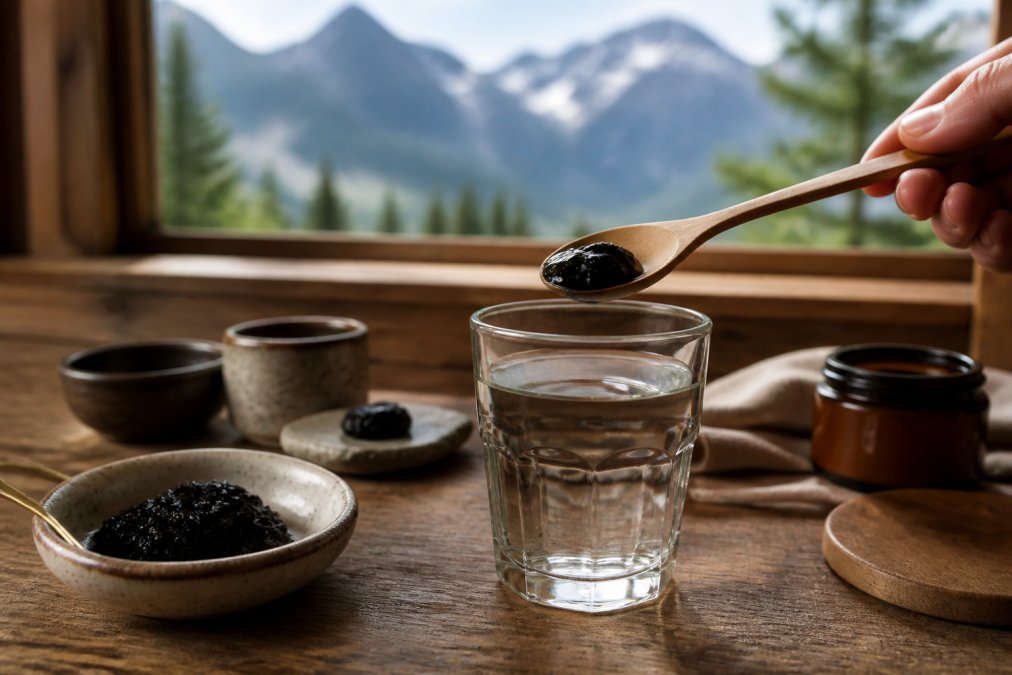
Start with a small dose to assess tolerance. Take it on an empty stomach in the morning for energy, or before a workout for endurance. Avoid coffee, as tannins can interfere with mineral absorption.
Resin vs. Powder vs. Capsules
The market offers natural shilajit in three primary forms. Resin is the traditional, unprocessed form offering the full spectrum of fulvic acid, humic acid, and trace minerals. Powder is convenient but can be more easily adulterated with fillers. Capsules offer the easiest dosing but often use standardized extracts that may lack the complete nutrient profile of raw resin.
| Form | Potency | Convenience | Risk of Adulteration | Best For |
|---|---|---|---|---|
| Resin | Highest | Moderate | Lowest (when tested) | Purists seeking full spectrum |
| Powder | Moderate | High | Higher | Travel and portability |
| Capsules | Variable | Highest | Highest | Easy daily dosing |
For most users, resin is the superior choice because it preserves the raw, mineral-dense structure that makes shilajit unique.
A Practical Shilajit Dosage Guide for Beginners
There is no single universal dosage for natural shilajit, but most experienced users recommend a starting dose of 300 to 500 milligrams per day, roughly the size of a pea or a grain of rice.
Start low and increase gradually. For the first week, take the smaller pea-sized amount; if you tolerate it well, increase to a slightly larger amount in the second week. Many users cycle five days on, two days off, or four weeks on, one week off, to prevent tolerance buildup.
Consistency matters more than the specific dose. Taking a small amount daily for several weeks will yield better results than taking a large amount sporadically.
Shilajit Side Effects, Safety, and Who Should Avoid It
While natural shilajit is generally well-tolerated, it is not for everyone. The most common side effects are mild digestive upset, often a sign the dose is too high, and a temporary energy increase that can feel jittery if taken too late in the day.
Certain groups should avoid shilajit entirely. Pregnant or nursing women should not use it due to a lack of safety data. Individuals with hemochromatosis should avoid it because fulvic acid can increase iron absorption. Those with active autoimmune conditions should also exercise caution, as shilajit can stimulate the immune system.
The most significant risk is not the shilajit itself but the source. Unpurified or adulterated resin can contain heavy metals, mycotoxins, or synthetic additives. Always look for a Certificate of Analysis, or COA, from an independent lab.
How to Verify Purity: Testing, Sourcing, and Red Flags
The shilajit market is crowded with products claiming to be "pure" and "authentic," but verification requires more than a label. A reputable brand will provide a Certificate of Analysis (COA) from an independent laboratory, showing specific results for heavy metals, microbial content, and fulvic and humic acid concentrations.
Not all COAs are created equal. A COA that simply lists "fulvic acid 50%" tells you nothing about safety. The specific assays, detection limits, and reference standards are where the real information lives.
Heavy Metal Testing: The ICP-MS Standard
The most critical test for shilajit is heavy metal analysis. The gold-standard method is Inductively Coupled Plasma Mass Spectrometry (ICP-MS). This technique can detect metals at parts-per-billion (ppb) levels, far more sensitive than older atomic absorption methods. When you ask a brand for their COA, check that it specifies ICP-MS as the method.
The specific metals to screen for are arsenic, lead, cadmium, and mercury. The FDA has established draft limits for these metals in dietary supplements. For reference, the FDA's proposed limits are 15 micrograms per day for lead, 5 micrograms per day for cadmium, and 15 micrograms per day for inorganic arsenic (the FDA). A COA should show results well below these limits, ideally in the low parts-per-billion range.
The Purification Process: What Actually Happens
Raw shilajit straight from the mountain is not safe to consume. It contains soil, plant debris, and potentially heavy metals absorbed from the surrounding geology.
The traditional method, water-solubilization, involves dissolving raw shilajit in warm water, filtering out insoluble debris, and slowly evaporating the water to concentrate the resin. It removes physical contaminants but not necessarily dissolved heavy metals.
More rigorous purification uses filtration steps, including activated charcoal or specialized resin columns, to bind and remove heavy metal ions. Ask a brand not "do you purify?" but "how do you purify, and can you show me test results before and after?" Testing only the final product may miss contamination introduced during processing.
Microbial and Mycotoxin Screening
Shilajit is an organic substance harvested from damp mountain environments, making it susceptible to microbial contamination. A proper COA should include testing for total aerobic microbial count, yeast and mold, and specific pathogens like E. coli, Salmonella, and Staphylococcus aureus.
Mycotoxins are a less-discussed but equally important concern. These toxic compounds, produced by molds that can grow on improperly stored shilajit, include aflatoxins, which are carcinogenic and regulated by the FDA. Ask if the COA includes mycotoxin screening.
The Chain of Custody Question
Sourcing transparency is the other pillar of verification. Wild-crafted shilajit, harvested by hand from a known location, offers a traceable chain of custody, contrasting sharply with mass-market products that blend inconsistent quality from multiple unknown locations.
Ask the brand: Who harvested this batch? What specific mountain or valley did it come from? Was it harvested in a single season or blended across multiple years? A single-origin, single-harvest product allows for batch-specific testing.
Red Flags to Watch For
Beyond the absence of a COA, several other red flags indicate a low-quality product:
- Vague sourcing language: "Himalayan shilajit" is a marketing term, not a sourcing specification. The Himalayas span thousands of miles across multiple countries. A reputable brand will name a specific region or valley.
- No batch number: Every container should have a batch number that corresponds to a specific COA. If the batch number is missing or the COA is not batch-specific, the testing is meaningless.
- Extremely low price: Genuine wild-crafted shilajit is labor-intensive to harvest. If the price is significantly below the market average, the product is likely blended, adulterated, or synthetic.
- Powder or capsules without testing: These forms are easier to adulterate with fillers. If a brand sells powder or capsules, they should provide the same level of testing as for their resin.
The verification process is not complicated, but it requires asking the right questions. A brand that cannot or will not provide batch-specific ICP-MS heavy metal testing, microbial screening, and mycotoxin analysis is not selling a product you should put in your body.
The Bottom Line on Choosing Natural Shilajit
Natural shilajit is a remarkable substance, but its benefits are only as reliable as its sourcing and purification. A cheap, untested product is not a bargain; it is a gamble with your health.
For those seeking the highest standard, Stoneblood Shilajit offers wild-crafted resin hand-harvested from the Rocky Mountains of Utah. Every batch is third-party tested for purity, and the product is bottled in a cGMP-certified facility with no additives or fillers. The single-person harvest ensures a clean chain of custody, from the rock to your hands.
Choosing the right supplement comes down to one question: can you verify what you are consuming? If the answer is no, keep looking. If the answer is yes, the potential for improved energy, focus, and overall well-being is substantial.
Frequently Asked Questions
How can you tell if shilajit is authentic and pure?
Authentic shilajit resin dissolves completely in warm water, leaving minimal sediment, and has a distinct earthy, smoky aroma with a bitter taste. The most reliable way to verify purity is to check for a Certificate of Analysis (COA) from a third-party lab. This document confirms the product is free from heavy metal contamination and lists its fulvic and humic acid content.
What does shilajit do for your body?
Natural shilajit is a mineral-dense substance that supports cellular energy production by aiding mitochondrial function and ATP production. Users commonly report improved focus, reduced brain fog, and better physical endurance. Its fulvic acid content also acts as an adaptogen, helping the body manage oxidative stress and supporting natural recovery after exercise.
Who should avoid taking shilajit?
Pregnant or nursing women, children, and individuals with active autoimmune conditions or gout should avoid shilajit without consulting a physician. Because shilajit can affect blood sugar and hormone levels, those with diabetes or on hormone therapy should also seek medical advice. Always ensure your product is third-party tested for contaminants, as impure sources can cause adverse reactions.
What is the recommended shilajit dosage for beginners?
For a standard resin, a pea-sized amount, roughly 300-500 mg, taken once daily is a common starting point. Dissolve it in warm water or milk and take it on an empty stomach in the morning. After one week, you can increase to twice daily if needed. Always follow the dosage guide on your specific product label and consult a healthcare provider for personalized advice.