
5 Ways to Spot Fake Shilajit Resin: A 2026 Guide

Table of Contents
- What Real Shilajit Resin Looks, Feels, and Tastes Like
- 1. The Flame Test: How Real Shilajit Resin Reacts to Heat
- 2. Solubility and Water Test: Does Your Shilajit Dissolve Cleanly?
- 3. Texture, Taste, and Smell: The Sensory Checks That Expose Fillers
- 4. How to Test Shilajit Purity at Home: Temperature and Consistency
- 5. Lab Reports and Sourcing: The Check That Home Tests Cannot Replace
- Shilajit Side Effects for Male Users: What Fake Resin Makes Worse
- Comparing the Checks
- Frequently Asked Questions
Last Updated: September 23, 2026
What Real Shilajit Resin Looks, Feels, and Tastes Like
Real shilajit resin is a soft, tar-like substance with a bitter taste and an earthy, smoky aroma, and it looks nothing like fake shilajit resin. It softens when warmed and hardens when cold. Nothing about it should look candy-like, smell sweet, or feel gritty.
1. The Flame Test: How Real Shilajit Resin Reacts to Heat
Real shilajit resin bubbles, swells, and puffs up when held near a flame, and it does not smell like burning plastic. It may soften, expand, and give off a faint earthy smoke. A fake loaded with wax, paraffin, or resin substitutes will melt flat, spit, or smell chemical.
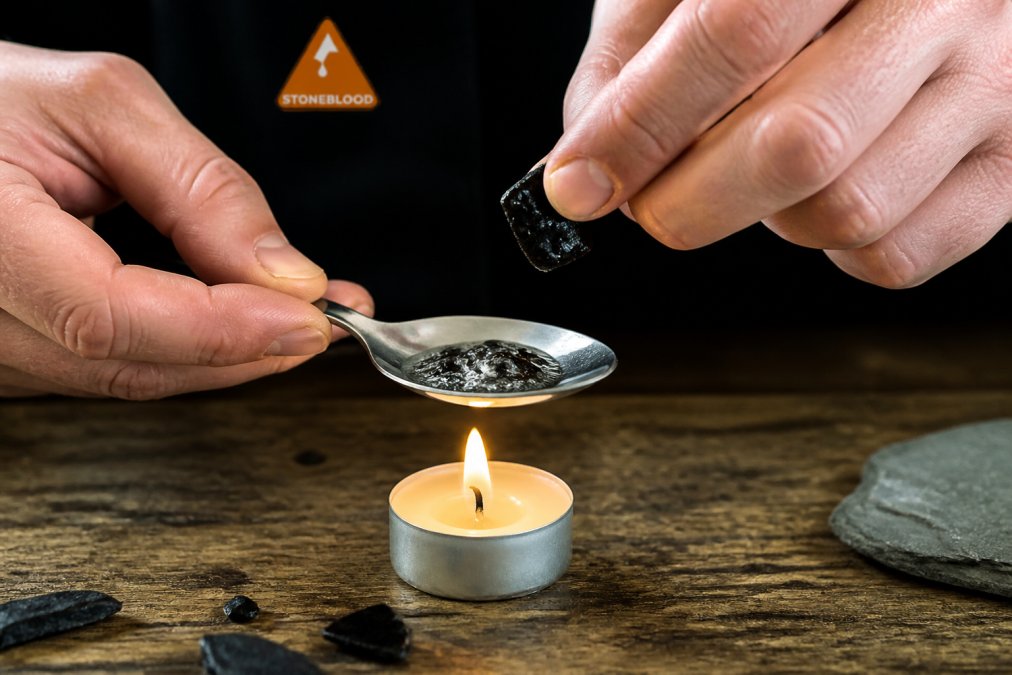
Here is how to run it safely:
- Put a small piece, roughly the size of a grain of rice, on a clean metal spoon.
- Hold the spoon several inches above a candle flame. Do not touch the resin to the flame.
- Watch for bubbling and expansion rather than a fast, watery melt.
- Note the smell. Earthy and mineral is normal. Acrid or plastic is a red flag.
- Let it cool. Real resin re-hardens into a brittle, glassy bead. Wax stays greasy and soft.
- Foams, swells, earthy smell, re-hardens: consistent with real resin.
- Foams weakly, smells slightly sweet: often a resin cut with a sugar-based bulking agent.
- Melts flat with no expansion: likely wax, paraffin, or a tar substitute.
- Sputters, spits, or smells like burning rubber: synthetic polymer or plasticizer.
- Burns with a bright, sooty flame: high hydrocarbon content, not humic material.
2. Solubility and Water Test: Does Your Shilajit Dissolve Cleanly?
Genuine shilajit dissolves in warm water and leaves little sediment. Drop a small amount into warm water and stir: real resin breaks down into a golden-brown to reddish-brown solution with a clean mineral cloud, while fakes float, clump, or drop chalky residue.
Watch for these outcomes:
- Clean dissolve, light sediment: consistent with real resin.
- Floats and will not mix: likely a wax or fat-based filler.
- Heavy grit or sand at the bottom: a sign of dirt or an added mineral powder.
- Bright, uniform color with no cloud: often a sign of dye or a diluted tonic.
3. Texture, Taste, and Smell: The Sensory Checks That Expose Fillers
Authentic resin is sticky, malleable, and slightly gritty when pressed, never powdery, crumbly, or slick like candy. Roll a pea-sized piece between your fingers; real resin leaves a tacky film that rinses off with warm water.
4. How to Test Shilajit Purity at Home: Temperature and Consistency
Temperature tells you a lot. Real resin softens in a warm hand and firms in a cold room, that malleability is a signature of the material. A product that stays rock-hard at room temperature or liquefies in a warm room is worth questioning.
Try this sequence:
- Chill a small piece in the refrigerator for ten minutes. It should firm up.
- Warm it in your palm for two minutes. It should soften and turn tacky.
- Press it flat. Real resin spreads without cracking.
- Smell it again after warming. The earthy aroma should intensify, not turn chemical.
5. Lab Reports and Sourcing: The Check That Home Tests Cannot Replace
Home tests catch obvious fakes, but they cannot detect heavy metals, microbial contamination, or low fulvic acid content, only laboratory testing does that. This is the gap most home-test guides skip, and it matters most for safety.
How to Actually Read a Certificate of Analysis
A CoA is only useful if you know what you're looking at. Most sellers post a PDF; few customers read past the logo. Check these, in order:
Shilajit Original — Stoneblood →
- Lot number match. The lot number on the CoA must match the lot number printed on your bottle. A generic CoA with no lot number proves nothing about your specific batch.
- Lab name and accreditation. The testing lab should be independent of the seller. Look for an ISO/IEC 17025 accreditation reference, which is the recognized standard for testing and calibration laboratories.
- Date. A CoA older than the batch it claims to cover is a red flag. Testing should be recent relative to the manufacturing date.
- Heavy metals panel. Look for lead, arsenic, cadmium, and mercury with reported values, not just a 'pass' stamp. Values should be reported in parts per million (ppm) or micrograms per gram (µg/g).
- Microbial panel. Total aerobic count, yeast and mold, E. coli, and Salmonella are the usual entries. Absence or 'not detected' is what you want.
- Fulvic acid content. Some labs report it; many do not. If a seller claims a specific percentage, the CoA should support it.
Why Heavy Metals Are the Real Concern
Shilajit is a concentrated mineral exudate, so it concentrates whatever was in the rock and soil it formed in, the source of its trace minerals and its risk. Poorly sourced or unrefined material can carry lead, arsenic, cadmium, and mercury at levels that matter with daily use. Heavy metals accumulate over time, so 'only slightly' contaminated is not a small problem when taken for months.
Sourcing Transparency: Why Color and Texture Vary
A common false negative: buyers reject genuine resin because it doesn't match a photo they saw online. Shilajit from different mountain ranges looks and behaves differently, that's normal.
- Himalayan resin tends to be dark brown to black, dense, and strongly bitter, reflecting the mineral profile of high-altitude rock in that region.
- Altai resin is often slightly softer and lighter in color, with a milder earthy note.
- Gilgit and other Central Asian resin can run from near-black to reddish-brown depending on how it was purified.
Ask three questions before buying:
- Where was the resin harvested?
- Can you trace this bottle back to a specific batch?
- Will you send me the CoA for my lot number on request?
Shilajit Side Effects for Male Users: What Fake Resin Makes Worse
Shilajit side effects for male users are usually mild in a pure product, but adulterated resin raises the risk considerably. The concern isn't shilajit itself, it's what a fake batch carries.
Comparing the Checks
| Check | What It Catches | What It Misses |
|---|---|---|
| Flame test | Wax, tar, plastic fillers | Heavy metals, low fulvic acid |
| Water solubility | Fillers, dyes, grit | Microbial contamination |
| Texture and taste | Sugar, flavoring, bulking agents | Contaminants, potency |
| Temperature response | Synthetic substitutes | Sourcing fraud |
| Lab reports and sourcing | Heavy metals, microbials, potency | Nothing, when the report is genuine |
No single test proves purity. Stacking them, and pairing them with a real certificate of analysis, gets you close.
Frequently Asked Questions
How can I tell if shilajit is original?
Real shilajit resin is soft and malleable at room temperature, dissolves almost completely in warm water, and has a bitter, earthy taste with a smoky aroma. It reacts to flame by bubbling and expanding rather than melting into a plastic-like pool. Fake shilajit resin often stays hard, leaves gritty sediment, or tastes sweet. No single test proves authenticity, so combine the flame test, solubility check, and a review of third-party lab reports before trusting any product.
Does real shilajit dissolve in water?
Yes. Authentic shilajit resin is water-soluble because it is refined in water and rich in fulvic acid. When you stir a small amount into warm water, it should dissolve into a golden-brown or reddish-brown liquid with little to no sediment. A cloudy, gritty residue or a layer of wax, tar, or plastic-like film at the bottom suggests fillers or adulteration. Cold water slows dissolution, so use warm water for the most accurate result.
What are the common fillers found in low-quality shilajit?
Low-quality shilajit is often cut with wax, tar, resin substitutes, powdered charcoal, or cheap plant gums to mimic the look and texture of real resin. Some products add synthetic fulvic acid or sugar to improve taste. These fillers reduce mineral content and can introduce contaminants. A product that tastes sweet, feels unusually hard, or leaves a plastic-like residue after the flame test is likely adulterated and should be avoided.
Is shilajit supposed to be hard or soft?
Pure shilajit resin is soft, sticky, and malleable at room temperature, similar to a thick tar or pine sap. It becomes harder in cold temperatures and softer in warmth, which is normal temperature sensitivity. A product that stays rock-hard at room temperature or crumbles into powder may be dried, diluted, or mixed with fillers. Texture alone is not proof, but extreme hardness combined with a sweet taste or poor solubility is a strong warning sign.
What are the side effects of fake shilajit for male users?
Fake shilajit resin can contain heavy metals such as lead, arsenic, and mercury, along with undisclosed fillers. For male users, this can mean digestive upset, fatigue, or longer-term exposure risks that outweigh any intended benefit for energy or vitality. Authentic shilajit side effects for male users are generally mild when the product is pure and third-party tested. Always check for a certificate of analysis from an accredited lab before buying.