
Shilajit Side Effects for Male: Safety Guide

Table of Contents
- What Shilajit Is and Why Men Use It
- Common Shilajit Side Effects for Male Users
- Hormonal Effects: Testosterone and Blood Pressure
- Shilajit Heavy Metal Contamination Risks
- How to Identify Pure Shilajit Resin
- Shilajit Dosage for Men: Safe Guidelines
- Managing Mild Side Effects and Cycle Protocols
- Who Should Avoid Shilajit
- Frequently Asked Questions
Last Updated: September 11, 2026
What Shilajit Is and Why Men Use It
Shilajit is a mineral-rich resin that seeps from high mountain rock formations, formed over centuries from compressed plant material and humus. It contains fulvic acid, humic acid, and trace minerals, which is why Ayurvedic tradition treats it as a restorative for energy, stamina, and recovery.
Men typically turn to shilajit for sustained energy without caffeine crashes, faster recovery after training, and natural vitality support. The caution is what most articles skip.
This guide from Stoneblood Shilajit covers the shilajit side effects men actually report, how to separate a genuine reaction from a contaminated product, and what a safe protocol looks like.
Common Shilajit Side Effects for Male Users
The most frequently reported shilajit side effects for male users are mild and short-lived: digestive discomfort, headaches, dizziness, and occasional skin reactions. Most settle within the first week.
That said, "mild" is not "ignore it." A reaction that persists past ten days, or escalates, is a signal to stop and reassess.
Digestive Issues and Gastrointestinal Distress
Gastrointestinal distress is the number one complaint, and it usually traces to dose size rather than the substance itself. Too much resin at once, or an empty stomach, produces nausea, abdominal discomfort, or loose stools. The fix: start with a fraction of a standard serving, take it with food, and increase slowly over one to two weeks. Men with a sensitive gut or acid reflux should be especially conservative.
Headaches, Dizziness, and Rapid Heart Rate
Headaches and dizziness typically appear when someone jumps straight to a full serving. Fulvic acid and mineral content can shift fluid and electrolyte balance, which the body registers as a mild headache or lightheaded moment.
A rapid heart rate is less common and more worth watching. If your pulse climbs noticeably after a dose, stop and speak with a physician before resuming. Caffeine stacking makes this worse, so separate coffee or pre-workout by several hours.
Hormonal Effects: Testosterone and Blood Pressure
Shilajit is often marketed for testosterone support, and that framing deserves scrutiny. Some men report improved libido and energy, which they attribute to higher testosterone, but individual response varies and shilajit is not a replacement for medical evaluation of low testosterone. What matters more for safety is blood pressure: shilajit can influence it in either direction, and the endocrine system is sensitive to mineral load. If you take blood pressure medication or monitor your own readings, track them before and during use.
Men with diagnosed hypertension, or those on thyroid or hormone therapy, should clear shilajit with their doctor first. Mineral-heavy supplements can interact with how the body handles medication.
Shilajit Heavy Metal Contamination Risks
Here is the part most guides bury: the biggest danger with shilajit is not the resin. It is what is in the resin.
Because shilajit is harvested from rock and soil, it can carry heavy metals and metalloids pulled from the surrounding geology. Products from regions with lax manufacturing oversight have been found to contain lead, arsenic, cadmium, and mercury at levels that pose real risk with daily use (peer-reviewed research). Heavy metal toxicity is cumulative, which is why it is easy to miss until it is a problem. The same geology that produces the resin also produces the contamination, so "pure Himalayan" or "pure Altai" tells you nothing about what the batch actually contains. Microbial contaminants matter too: a resin handled without proper controls can carry bacteria, and a powdered extract cut with fillers can carry anything the filler carried.
Why the Certificate of Analysis Is the Only Thing That Matters
Third-party testing is the single most important safety feature of any shilajit product, and the thing to check before anything else. But "third-party tested" has become a sticker claim, so the useful skill is knowing how to read the document behind it.
A legitimate certificate of analysis (COA) has a few non-negotiables:
- A named, accredited lab. The lab should be identifiable and independent of the seller. If the COA has no lab name, or the lab is the seller's own facility, it is not third-party testing.
- A batch or lot number that matches your product. A COA for a different batch tells you nothing about the jar in your hand. Ask the seller for the COA matching the lot number on your container.
- Method and detection limits. Look for the analytical method (often ICP-MS for heavy metals) and the reporting limit. A result of "pass" with no number is not a result, you want the measured value per metal, in parts per million or micrograms per serving.
- A test date. Heavy metal content does not change over time, but a COA from three years ago may not reflect current sourcing. Recent is better.
- Microbial and, ideally, identity testing. Heavy metals are the headline, but total plate count, yeast and mold, E. coli, and salmonella results matter for a raw resin. Fulvic acid content or a fingerprint test confirms the material is actually shilajit, not a cut powder.
How to Verify a COA Before You Buy
A few practical steps separate a real testing program from a decorative PDF:
- Request the COA for the current batch before purchase. A seller who cannot or will not produce it is telling you something.
- Match the lot number. The number on the COA must match the number on your container, or the test does not apply to your product.
- Check the lab independently. An accredited, established lab is a stronger signal than an unfamiliar one with no web presence.
- Read the numbers, not the checkmarks. A COA that only shows "PASS" columns without measured values gives you nothing to evaluate.
- Re-test if you want certainty. For men using shilajit daily for months, a consumer-accessible heavy metal test (hair, urine, or a mail-in panel ordered through a physician) can confirm whether accumulation is occurring, the only way to know your personal exposure rather than trusting a label.
If you are stacking shilajit with other mineral-containing supplements, remember that heavy metal exposure is additive. Two products that each pass individually can still combine into a meaningful daily load, which is one more reason to know the numbers on every batch you use.
How to Identify Pure Shilajit Resin
Pure shilajit resin has a few physical tells, and a few documentation tells. You need both.
Start with the paperwork. A trustworthy seller provides a certificate of analysis from an accredited third-party lab, showing heavy metal and microbial results for the specific batch you are buying. If you cannot see the test results before purchase, treat the purity claim as unproven.
Then check the physical product:
- Resin form: Genuine resin is soft, tar-like, and pliable at room temperature. It softens further when you roll it between warm fingers.
- Solubility: Pure resin dissolves in warm water or milk, leaving little to no gritty sediment behind.
- Smell and taste: Expect a strong, earthy, slightly bitter mineral smell. A sweet or neutral smell can indicate dilution.
- No additives: Pure resin should list one ingredient. Anything with fillers, sweeteners, or "proprietary blends" is a different product.
Powdered extract is harder to assess by eye, which is one reason resin remains the more verifiable format. FDA guidance on dietary supplement labeling outlines what supplement labels must disclose, and it is worth knowing what a compliant label actually looks like.
Stoneblood Shilajit is wildcrafted from the Rocky Mountains and hand-harvested by a single person, which keeps the chain of custody short and traceable. Every batch is third-party tested for heavy metals and microbials, and the resin is bottled in a cGMP-certified facility. If you want to see what that documentation looks like in practice, the Stoneblood American Shilajit - Magic Brown page walks through it.

Shilajit Dosage for Men: Safe Guidelines
A safe starting dose for most men is a small amount of resin, roughly the size of a grain of rice, taken once daily. Hold at that level for the first week before considering any increase.
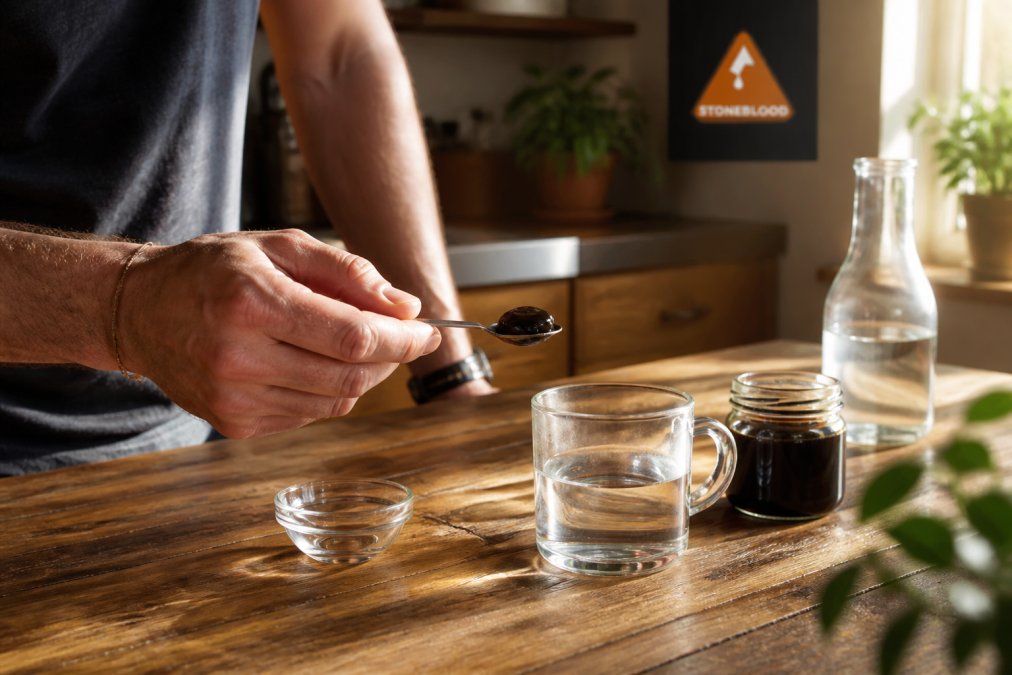
Timing matters as much as quantity. Morning dosing, with or after food, produces the fewest digestive complaints. Late-day dosing can interfere with sleep for men sensitive to the energizing effect.
| Factor | Conservative Approach | Why It Matters |
|---|---|---|
| Starting amount | Grain-of-rice size, once daily | Limits digestive upset during adjustment |
| Timing | Morning, with food | Reduces nausea and sleep disruption |
| Increase pace | Only after 7-10 stable days | Lets you isolate any reaction |
| Caffeine spacing | Separate by several hours | Avoids compounding heart rate effects |
| Hydration | Plenty of water through the day | Supports mineral and electrolyte balance |
If you are stacking shilajit with other supplements, introduce one new product at a time. A reaction you cannot attribute to a single variable is a reaction you cannot fix.
Managing Mild Side Effects and Cycle Protocols
Most mild side effects resolve with three adjustments: lower the dose, take it with food, and add water. But "lower the dose" is not a protocol, so here is what to actually do, symptom by symptom.
Symptom-by-Symptom Management
Nausea or stomach upset. Almost always a dose or timing issue. Cut your amount in half and take it immediately after a meal rather than on an empty stomach. Hold there for three to five days; if nausea is gone, stay a week before considering any increase. If it persists at half dose after five days, stop for seven days and restart at the smallest amount you can measure.
Loose stools or diarrhea. Reduce to half dose with food for three days. If it continues, pause five to seven days to let your gut reset, then restart at a quarter of your original dose. Diarrhea persisting past a week of reduced dosing is a stop-and-consult signal, because it can deplete electrolytes.
Headache. Usually tracks to fluid and electrolyte shifts. Drop to half dose, increase water intake, and take the dose with food. Most resolve within two to three days at the lower amount. If a headache is severe, sudden, or accompanied by vision changes, stop immediately and seek medical care, that is not a normal adjustment reaction.
Dizziness or lightheadedness. Stop the dose for the day and do not drive or train until it passes. On restart, use half the previous amount with food. If dizziness recurs at the reduced dose, discontinue and speak with a physician, because it can signal a blood pressure effect.
Rapid or noticeably elevated heart rate. Stop taking shilajit and do not resume until you have spoken with a physician. Separate shilajit from caffeine and pre-workout by at least four hours if you continue, since stimulants compound the effect.
Skin reactions (rash, hives, itching). Stop immediately. Hives, swelling of the lips or throat, or difficulty breathing are signs of a serious allergic reaction and warrant urgent care. A mild rash after a dose is a reason to discontinue and consult a physician before further use.
Cycle Protocols for Men
For men who want to use shilajit long-term, cycling is the practical answer. A common approach is eight to twelve weeks on, followed by two to four weeks off. The break confirms the product is still doing what you think it is doing and gives your body a reset from continuous mineral load. A few principles make cycling useful rather than arbitrary:
- Run the first cycle at the lowest effective dose. You are establishing a baseline, not chasing a maximum.
- Take the full off-period, even if you feel great. The off weeks are what tell you whether the effects were real or coincidental.
- Reassess at the end of each cycle. If the benefits do not return after the off-period, the product may not be doing what you assumed.
- Do not stack cycles back-to-back without a break. Continuous daily use for months without an off-period removes the reset that cycling is meant to provide.
Track your response during the first cycle, energy, sleep, digestion, resting heart rate, so you have a baseline to compare against when you restart.
Who Should Avoid Shilajit
Shilajit is not appropriate for everyone. Skip it, or get explicit medical clearance first, if any of the following apply to you:
- You are taking blood pressure, thyroid, or hormone medication
- You have diagnosed hypertension or a cardiovascular condition
- You have a known iron overload condition, since mineral content can compound it
- You have kidney or liver conditions affecting how your body processes minerals
- You have a diagnosed autoimmune condition
- You are under 18
- You have a known allergy to any component, or you develop hives or swelling after a dose
Pregnant and breastfeeding men's partners aside, this list is about you. If you are unsure whether shilajit fits your situation, that question belongs to your physician, not a product page. NIH Office of Dietary Supplements guidance is a useful starting point for understanding how mineral supplements interact with medications and existing conditions.
For healthy men without those flags, the risk profile is manageable when the product is genuinely pure and the dose is sensible. The variable that decides it is sourcing.
The challenge with shilajit is not deciding whether to try it. It is finding a product whose purity you can actually verify, because that single factor determines whether you get the benefits or the side effects. Stoneblood Shilajit addresses that directly: wildcrafted North American resin hand-harvested by the founder, refined in distilled Rocky Mountain spring water, bottled in a cGMP-certified facility, and third-party tested for heavy metals and microbials on every batch. If you want a shilajit where the safety documentation comes before the marketing, start with the Stoneblood Shilajit resin and read the batch testing before your first dose.

Frequently Asked Questions
What happens if a man takes shilajit?
Most men who take shilajit at a standard dose of 300 to 500 mg daily report improved energy, focus, and recovery with no serious problems. Mild shilajit side effects can include stomach upset, headaches, or dizziness, especially in the first week. Taking it with food and starting at a lower dose reduces these reactions. Men on blood pressure or diabetes medication should check with a doctor first, since shilajit can affect iron levels and blood pressure.
What are the risks of taking raw or unpurified shilajit?
Raw shilajit straight from the rock contains heavy metals, mycotoxins, and free radicals that purification removes. Taking unpurified resin raises your risk of heavy metal toxicity, liver stress, and gastrointestinal distress. Always buy from a seller who provides a certificate of analysis from a third-party lab showing lead, arsenic, mercury, and cadmium levels below safety limits. Purified resin in a cGMP-certified facility is the only form worth taking.
How can men identify high-quality, safe shilajit resin?
Pure shilajit resin dissolves in warm water without gritty sediment, has a bitter mineral taste, and softens between your fingers rather than crumbling. Ask the seller for a batch-specific certificate of analysis from an ISO-accredited lab. Stoneblood Shilajit, for example, is hand-harvested in the Rocky Mountains and third-party tested by New Wave Scientific for heavy metals and microbials. If a brand will not share lab results, walk away.
What are the signs of a shilajit allergy or adverse reaction?
Signs of an allergic reaction include hives, skin rash, itching, swelling of the lips or face, and difficulty breathing. Stop taking shilajit immediately and seek medical help if breathing is affected. Less severe reactions like nausea, abdominal discomfort, or headaches usually fade when you lower the dose or take it with food. Men with a history of iron overload should avoid shilajit entirely, since its fulvic acid and mineral content can raise iron absorption.