
How to Verify Shilajit Purity: 7 Science-Backed Steps

Table of Contents
- Why Shilajit Purity Matters and What You're Actually Testing For
- Step 1: Visual Inspection - Texture, Color, and Resin Consistency
- Step 2: The Water Solubility Test and Dissolution Check
- Step 3: The Burn Test and Smell Evaluation
- Signs of Fake Shilajit: Adulterants, Fillers, and Synthetic Resins
- Microscopic Analysis and Adulterant Identification
- Third-Party Lab Testing for Supplements: COAs and Heavy Metal Screening
- Geographic Sourcing Impact: Himalayan vs. North American Shilajit
- Frequently Asked Questions
Last Updated: September 17, 2026
Why Shilajit Purity Matters and What You're Actually Testing For
Verifying shilajit purity starts with knowing what authentic resin is. Shilajit is a mineral-rich resin that seeps from rock formations in high mountain ranges, formed over centuries from compressed plant material and humus, containing fulvic acid, humic acid, and more than 85 trace minerals in ionic form.
Step 1: Visual Inspection - Texture, Color, and Resin Consistency
Authentic shilajit resin is dark brown to black, glossy, and slightly sticky, softening when warmed between your fingers and leaving a faint residue. It should feel like thick tar or pine sap, not brittle or powdery.
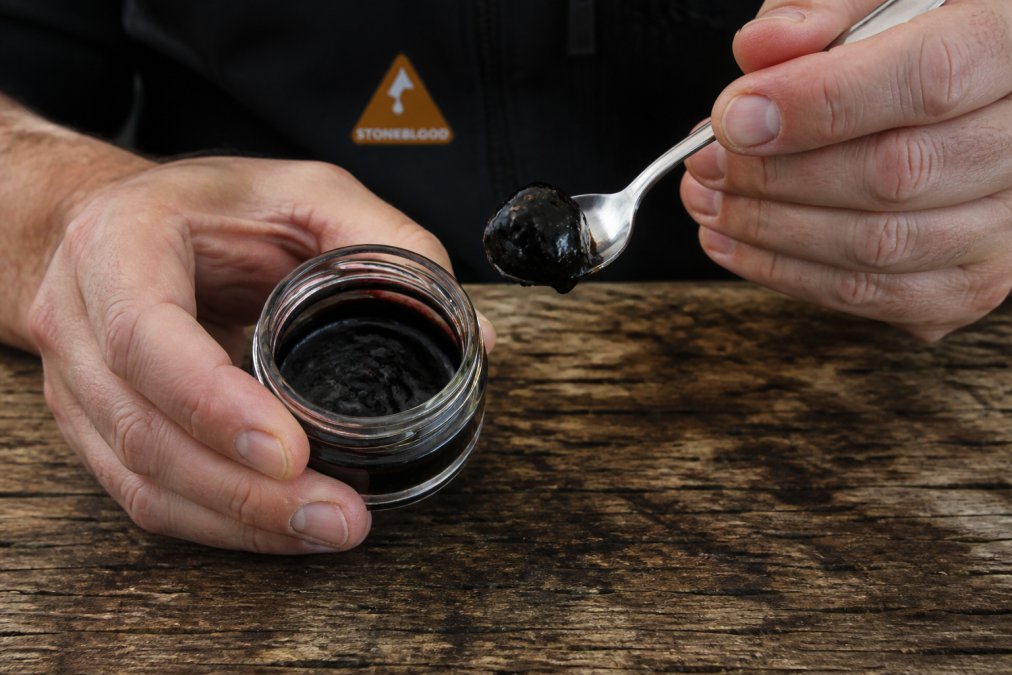
What Authentic Shilajit Resin Looks Like
Real resin has a non-uniform surface; small variations in color and sheen are normal in a wildcrafted material. Perfectly uniform resin or a plastic-like gloss is a warning sign.
Red Flags: Fillers and Synthetic Resins
Hard, crumbly chunks that snap instead of bending usually mean filler, as does a resin that smells like nothing. Malleability is hard to fake, making it one of the most reliable early checks.
Step 2: The Water Solubility Test and Dissolution Check
Genuine shilajit dissolves in warm water, leaving minimal residue. Drop a small amount into a glass of warm water and stir; authentic resin breaks down into a dark amber solution within minutes.
Step 3: The Burn Test and Smell Evaluation
The burn test measures ash content; the smell test checks organoleptic properties. Hold a small piece over a flame: authentic shilajit bubbles, melts, and releases a smoky, earthy aroma rather than a chemical or plastic smell.
What the Flame Test Reveals About Ash Content
Resin that burns cleanly with minimal ash is a good sign. Large amounts of white or gray ash suggest mineral fillers or plant matter, and high ash content is one of the most common markers of adulteration.
Organoleptic Properties: Aroma and Taste
Authentic shilajit smells like damp earth and molasses, with a bitter, slightly salty, lingering taste. A sweet or neutral taste usually means the resin was cut with sugar, maltodextrin, or another filler.
Signs of Fake Shilajit: Adulterants, Fillers, and Synthetic Resins
The most common adulterants in fake shilajit are maltodextrin, glucose syrup, charcoal powder, and cheap plant gums. They mimic color and texture but contain none of the fulvic acid or minerals authentic resin delivers.
Watch for these signs of fake shilajit:
- A price far below the market average for wildcrafted resin
- No lot number, batch code, or best-by date on the packaging
- Vague sourcing claims with no specific region named
- No certificate of analysis available on request
- Resin that stays hard at room temperature and never softens
Microscopic Analysis and Adulterant Identification
Most home-testing guides stop at the water glass and the flame. Microscopy moves past "does it look right" to identifying what is actually in the sample, and a basic compound microscope with 40x, 100x, and 400x objectives is enough to separate authentic resin from common fillers.
How to Prepare a Slide
- Dissolve a pinhead-sized piece of resin in a few drops of warm distilled water on a clean glass slide; let it sit two to three minutes so the soluble fraction disperses.
- Place a coverslip over the drop and press gently to flatten it into a thin film.
- Start at 40x to find a well-spread area, then move to 100x and 400x. Lower the condenser slightly, harsh light washes out translucent organic structures.
What Authentic Resin Looks Like Under Magnification
Authentic shilajit is a relatively uniform, gel-like organic matrix with fine mineral particles suspended evenly rather than clumped. Occasional plant fibers or humus are expected in wildcrafted resin. What you should not see is a dominant crystal habit, sharp angular shards, or large opaque chunks on top of the matrix.
Shilajit Original — Stoneblood →
What Common Adulterants Look Like
- Maltodextrin and glucose syrup solids: smooth, angular, often rhomboid or blocky crystals with clean edges that can flash brightly under polarized light. Authentic resin does not form clean geometric crystals.
- Charcoal powder: opaque black fragments that stay solid and sit on the matrix surface rather than dissolving into it.
- Plant gums (guar, acacia, xanthan): fibrous, stringy strands or swollen gel blobs, distinctly different from real resin's fine granular mineral dispersion.
- Starch: rounded, sometimes concentric granules that turn blue-black with a drop of iodine, a quick confirmatory test.
- Soil, clay, or sand: dense, opaque, irregular grains that sink and settle rather than staying suspended, the same material behind the sandy layer in the solubility test.
What Microscopy Cannot Tell You
Microscopy is a filler-detection tool, not a safety test. It cannot identify heavy metals (lead, arsenic, cadmium, and mercury sit far below what any light microscope resolves), detect microbial contamination, or quantify fulvic acid. A sample can look perfectly clean under 400x and still fail a heavy metals panel. Treat microscopy as a fast, cheap screen, not a substitute for a lab test.
Third-Party Lab Testing for Supplements: COAs and Heavy Metal Screening
Third-party lab testing is the only method that confirms safety. A certificate of analysis (COA) is a document from an independent laboratory reporting measured contaminant concentrations in a specific batch. But "we have a COA" has become a marketing line, and many documents online are unaccredited, undated, or copied from another product. Knowing what a legitimate report contains separates real verification from a decorative PDF.
How to Read a Certificate of Analysis
A legitimate COA ties a specific batch to a specific test. Check for these elements before you read a single number:
- Lot or batch number that matches the number printed on your jar. If it does not match, the report is not for your product.
- Laboratory name and address, plus an accreditation number you can look up independently.
- Sample receipt date and report date. A report older than the batch it claims to cover is a red flag.
- Method references for each test, for heavy metals, that means ICP-MS (inductively coupled plasma mass spectrometry).
- Individual results with units, not a summary "pass." You want to see each metal reported separately in mg/kg or ppm, alongside the reporting limit for that method.
- Microbial results reported as actual counts: total aerobic plate count, yeast and mold, and absence/presence for Salmonella and E. coli.
Standardized Testing Protocols and ISO/IEC 17025 Labs
ISO/IEC 17025 is the international standard for testing and calibration laboratory competence. An accredited lab has been independently assessed on its methods, equipment, staff qualifications, and quality system, not just on whether it owns a mass spectrometer. That accreditation separates a reliable result from one that merely looks official.
What the Numbers Should Look Like
Heavy metals are reported individually because each has a different toxicity profile and acceptable limit. Rather than memorizing thresholds, focus on three things:
- Are all four metals reported? Lead, arsenic, cadmium, and mercury. A report that omits one is incomplete.
- Is the result below the reporting limit, or a measured value? Both can be acceptable, but a measured value near the limit deserves scrutiny.
- Is the reporting limit low enough to be meaningful? A method that only detects lead at a high threshold tells you little. ICP-MS is used because it reaches very low detection limits.
Verifying the Report Is Real
A COA is only as good as your ability to confirm it. Three quick checks catch most fakes:
- Search the lab's accreditation number in the accrediting body's public directory. If it does not appear, the report is not credible.
- Call or email the lab directly and ask them to confirm the report number and batch. Reputable labs will confirm whether they issued a document.
- Compare the lot number on the report to the lot number on your packaging. Mismatches are the single most common sign of a recycled or borrowed COA.
Geographic Sourcing Impact: Himalayan vs. North American Shilajit
Sourcing region affects mineral profile, contamination risk, and supply chain traceability. Himalayan shilajit has the longer historical record but passes through more hands before bottling.
| Verification Method | What It Detects | What It Misses |
|---|---|---|
| Visual inspection | Fillers, synthetic resin | Heavy metals, microbes |
| Solubility test | Insoluble adulterants | Soluble fillers |
| Burn test | Ash content | Contaminant identity |
| Microscopy | Filler particles | Chemical contaminants |
| COA review | Heavy metals, microbials | Nothing, when legitimate |
Frequently Asked Questions
How can I test the purity of shilajit at home?
Start with visual inspection: authentic shilajit resin is dark brown to black, glossy, and pliable. Try the water solubility test, since pure shilajit dissolves completely in warm water without residue. The burn test should produce a subtle herbal smell, not plastic or chemical odors. These home tests help spot obvious fakes, but they cannot detect heavy metals or confirm fulvic acid content. For that, you need a third-party lab report.
What are the signs of fake shilajit?
Common signs include a sticky, gum-like texture that does not harden in cold temperatures, a chemical or burnt plastic smell, incomplete dissolution in water, and unusually low prices. Fake shilajit often contains fillers like guar gum, starch, or synthetic resin. Some products are cut with cheap molasses or charcoal. If a brand cannot provide a lot-specific certificate of analysis from an accredited lab, treat that as a major red flag.
Are there third-party lab tests I should look for when buying shilajit?
Look for a certificate of analysis (COA) from an ISO/IEC 17025 accredited laboratory. The COA should report heavy metals (arsenic, lead, cadmium, mercury) tested by ICP-MS, microbial screening, and ideally fulvic acid content. Stoneblood Shilajit, for example, tests every batch with New Wave Scientific and MiChem Analytical Laboratory, and lot numbers on bottles let you request your specific batch results.
Is shilajit safe for long-term consumption?
Pure, third-party tested shilajit is generally considered safe for daily use when taken at recommended amounts. The main risks come from contaminated products, especially those with heavy metals or undeclared additives. Shilajit side effects for male users are rare but can include digestive upset if taken in excess. Always check for a COA, follow dosage instructions, and consult a healthcare provider if you take medications or have kidney or liver conditions.