
Where to Buy Shilajit: A 2026 Buyer's Guide

Table of Contents
- Where to Buy Shilajit: The Channels Worth Considering
- How to Verify a Seller Before You Buy Shilajit
- Shilajit Quality Standards: What a Real Product Meets
- Sourcing Ethics and Geographic Origin: Why Utah Matters
- How to Use Liquid Shilajit Drops Once It Arrives
- What Liquid Shilajit Costs and What You Get
- Frequently Asked Questions
Last Updated: September 28, 2026
Where to Buy Shilajit: The Channels Worth Considering
Knowing where to buy shilajit comes down to three real options: a brand's own website, a specialty herbal retailer, or a large marketplace. Only one of those gives you a traceable chain of custody.
What to Avoid in Any Channel
Skip any listing that hides the source. A legitimate seller names the region, the harvest method, and the lab that tested the batch. If a product page shows no origin, no lot number, and no testing documentation, you have no way to confirm what is in the bottle.
Three more red flags:
- Unusually low prices. Wildcrafting and third-party testing cost money. A price far below the rest of the category usually means fillers, dilution, or a different substance entirely.
- Vague purity claims. "100% pure" without a certificate is marketing, not evidence.
- No contact information. Real sellers answer questions. If you cannot email a company about its testing, walk away.
How to Verify a Seller Before You Buy Shilajit
Verification happens in two stages: what you can check before you order, and what you can check once the bottle is in your hand. Most buying guides stop at the first stage. The second stage is where you actually learn whether the seller told you the truth.
Before You Order: The Paper Trail
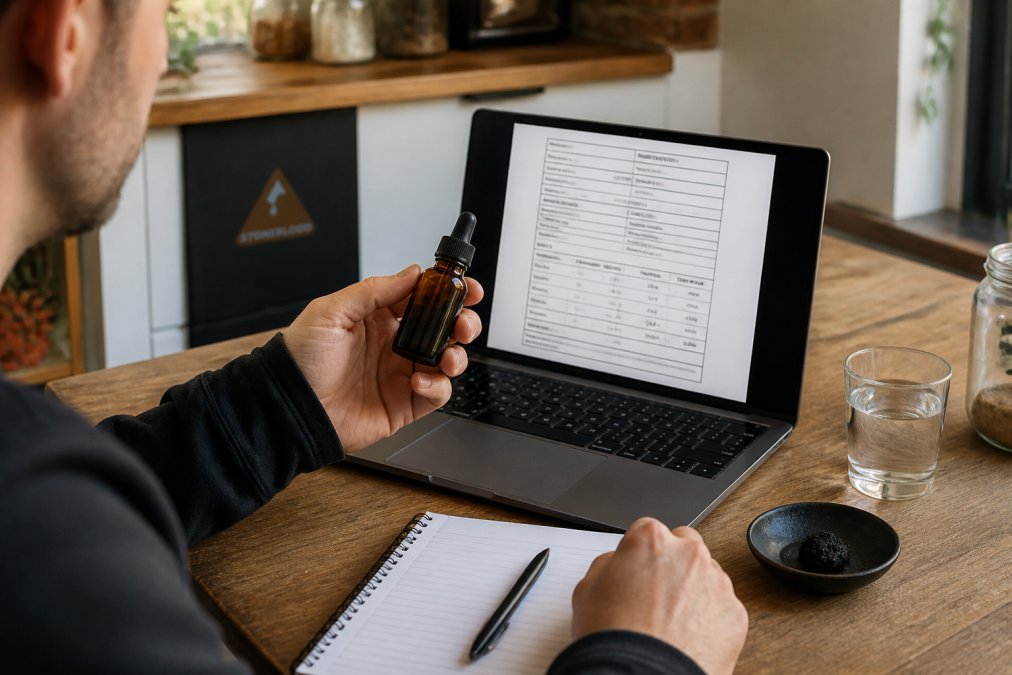
Ask the seller for a lot-specific certificate of analysis, then confirm that the lot number on the document matches the number printed on your bottle when it arrives. A few questions worth sending before you buy:
- Which laboratory performed the testing, and is it accredited?
- Can you share results for the exact lot I will receive?
- Where was the raw material harvested, and by whom?
- Is the finished product bottled in a facility that follows current good manufacturing practice?
After It Arrives: The Dissolve Test
Raw shilajit is a resin in nature, sticky, tarlike, and slow to break down in water. That behavior is the basis of the oldest authenticity check buyers use, and it costs nothing to run.
- Drop a small amount into a glass of warm water. Warm, not boiling, boiling water can scorch the material and muddy the result.
- Stir gently and watch. Genuine shilajit disperses into a uniform amber-to-brown cloud with no grit settling at the bottom. A product that leaves sand-like sediment, floating flakes, or a waxy film is usually cut with something else.
- Smell it. Real shilajit has a strong, earthy, almost smoky mineral scent, closer to damp soil than to candy. A sweet or neutral smell often signals a flavored or heavily diluted product.
- Taste a tiny amount. The flavor is bitter and mineral-forward. It should not taste sugary, salty, or like nothing at all.
Reading a Purity Certificate
A certificate of analysis, or COA, is a lab report showing what was tested and what was found. The useful parts are the heavy metal screening, the microbial panel, and the accreditation number of the lab itself.
The Questions Sellers Hope You Won't Ask
A short list separates a real supplier from a reseller:
- "Which lot is shipping this week?" A broker cannot answer. A manufacturer can.
- "Who harvested the raw material?" Vague answers like "our partners in the Himalayas" usually mean the seller has never met the harvester.
- "What happens if the COA doesn't match my bottle?" A real seller has a return policy for exactly this case.
- "Can you send the COA before I pay?" Testing is done per batch, so the document should already exist.
Shilajit Quality Standards: What a Real Product Meets
A genuine product meets four standards: documented origin, accredited third-party testing, cGMP-certified bottling, and a lot number that ties the bottle to a specific batch. Miss any one of those and you are trusting a claim rather than a record.
| Standard | What It Confirms | How to Check |
|---|---|---|
| Documented origin | Where the raw material came from | Seller names the region and harvest method |
| Third-party testing | Heavy metals and microbials screened | Lot-specific COA from an accredited lab |
| cGMP bottling | Facility meets current good manufacturing practice | Certificate number on request |
| Lot traceability | Your bottle matches its test results | Lot number printed on the label |
Sourcing Ethics and Geographic Origin: Why Utah Matters
Origin is not a marketing detail. It tells you what the raw material was, how many times it changed hands, and how much of the original substance survived to the bottle. Most buying guides mention Himalayan shilajit and stop there. The more useful question is what actually differs between regions, and why a shorter supply chain matters more than a famous mountain range.
What Shilajit Actually Is, Geologically
Shilajit forms when compressed plant matter and humus break down over long periods in rock crevices, then seep out as a thick, sticky resin. The process is slow and depends on three things: the plant material that went in, the minerals in the surrounding rock, and the moisture and temperature of the environment. Change any of those and you change the finished material.
Shilajit Original — Stoneblood →
The Handoff Problem
Here is the part most guides skip. Raw shilajit is heavy, sticky, and hard to transport, so it usually passes through several hands before it reaches a bottler:
- The harvester collects resin from rock crevices, often at high altitude and in a short seasonal window.
- A local aggregator buys from multiple harvesters and combines the material.
- A regional broker exports it, sometimes re-packaging along the way.
- An importer sells to a brand or a contract manufacturer.
- The bottler refines and packages the finished product.
Why the Harvest Method Matters
Wildcrafting is not the same as farming, and the difference shows up in the material:
- Hand collection targets mature resin that has already seeped from the rock, leaving the source intact for future seasons.
- Aggressive scraping removes material before it is fully formed and can damage the rock face, reducing what is available next year.
- Solvent-based extraction at the raw-material stage can strip or alter the natural fulvic and humic acid content before the brand ever sees it.
What This Means for You as a Buyer
- Can the seller name the region and the harvester? If yes, the chain of custody is short enough to verify.
- Is the raw material refined in the same region it was harvested? Long-distance shipping of raw resin increases the number of hands it passes through.
- Does the seller describe the refinement process? Water-based refinement preserves the natural fulvic and humic acid content better than harsh chemical extraction.
If you want to see how Stoneblood handles sourcing and testing end to end, our quality and safety page documents the process.
How to Use Liquid Shilajit Drops Once It Arrives
Liquid drops are the easiest form to work into a routine. Follow the label directions: take 1 dropper, about 10 to 15 drops, once daily. Mix it into water, coffee, tea, or food, or hold it under your tongue if you do not mind the earthy taste.
A few practical notes from using it ourselves:
- Stir it into warm coffee or tea and it dissolves cleanly.
- The flavor is strong and mineral-forward. Some people love it immediately; others mix it into a smoothie for the first week.
- Store the bottle as directed on the label and keep the dropper clean.
What Liquid Shilajit Costs and What You Get
Stoneblood's lineup is straightforward:
| Product | Size | Price | Best For |
|---|---|---|---|
| Magic Brown Liquid Shilajit Drops | 1 fl oz (30 ml) | $63.00 | Anyone wanting our strongest drops |
| Shilajit Original Liquid Drops | 1 fl oz (30 ml) | $33.00 | First-time buyers |
| Shilajit Original 3-Bottle Pack | 3 x 1 fl oz | $87.00 | Daily users stocking up |
Each bottle is a 1 fl oz (30 ml) dropper bottle of wildcrafted North American shilajit, refined in Utah and bottled from a third-party-tested batch.


Frequently Asked Questions
Can you buy shilajit in stores?
Most shilajit is sold online directly by the producer, which makes it easier to trace the batch. A few natural health retailers carry it, but shelf stock often sits for months and staff rarely know the extraction method or testing history. If you buy in person, ask for the lot number and the third-party test results before you pay. A seller who cannot produce either is not worth the risk.
What should I look for when buying shilajit?
Check four things: a named harvest region, a stated extraction method, third-party testing for heavy metals and microbials, and a lot number on the bottle. Ask who did the testing and whether you can see the results. Stoneblood publishes batch testing and shares certificates of analysis by lot; the lot number is printed on your bottle. Sellers who dodge these questions usually have something to hide about sourcing or adulteration.
Is liquid shilajit easier to use than other forms?
Liquid drops are the simplest option for most people. You take one dropper, about 10 to 15 drops, daily in water, coffee, tea or food, or under the tongue. There is nothing to measure, break apart or dissolve, and no strong tar texture to work around. Raw shilajit is a resin in nature; a good producer refines it into a water-soluble liquid so it mixes cleanly into any drink.
How can I verify the quality of shilajit products?
Start with the lot number and the certificate of analysis. The certificate should come from an accredited lab and cover heavy metal screening and microbial testing. Stoneblood uses New Wave Scientific, an ISO/IEC 17025 accredited laboratory, and bottles in a cGMP-certified facility. If a brand shows no lot code, no lab name and no way to request results, treat the purity claim as marketing rather than evidence.