
Is Raw Shilajit Resin Worth the Price? A 2026 Review

Table of Contents
- What $63 Actually Buys You: A Cost-Per-Serving Breakdown
- Why Raw Shilajit Resin Costs More Than Powder or Capsules
- How to Identify Authentic Shilajit Resin Before You Buy
- Shilajit Benefits and Side Effects: What the Evidence Supports
- Shilajit Dosage and Usage Guide: How Far a Bottle Really Goes
- Heavy Metals, Microbial Contamination, and the Testing That Matters
- Geographic Sourcing and Long-Term Value: Why Origin Changes the Math
- Verdict: Who Should Pay for Raw Shilajit Resin (and Who Shouldn't)
- Frequently Asked Questions
Last Updated: September 21, 2026
What $63 Actually Buys You: A Cost-Per-Serving Breakdown
Raw shilajit resin is worth the price when the cost per serving lands under a dollar and the batch carries verifiable third-party testing. It stops being worth it when you're paying for imported mystery tar with no certificate of analysis. Stoneblood Shilajit's Magic Brown resin costs $63.00 for a 1 fl oz (30 ml) bottle, and one dropper (about 10-15 drops) covers a full day.

| Purchase | Price | Servings | Cost Per Day |
|---|---|---|---|
| Stoneblood Magic Brown (1 bottle) | $63.00 | ~30 | ~$2.10 |
| Stoneblood Original (1 bottle) | $33.00 | ~30 | ~$1.10 |
| Stoneblood 3-Bottle Pack | $87.00 | ~90 | ~$0.97 |
Why Raw Shilajit Resin Costs More Than Powder or Capsules
Resin costs more because it's the least processed form. Powder and capsules go through drying, milling, and often standardization with excipients. Resin skips most of that: a raw material that oozes from rock as a thick, tar-like substance, then gets purified in distilled water rather than cooked into a shelf-stable powder.
Bioavailability: Resin vs. Powder vs. Capsules
Bioavailability is how much of a substance your body actually absorbs and uses. Resin is traditionally taken sublingually or mixed into liquid, which many practitioners believe supports faster uptake than a dry capsule that must break down in the gut. Fulvic acid, the key component in shilajit, helps transport trace minerals into your cells. When a powder is heavily diluted or a capsule is packed with fillers, you get less of that transport mechanism per dose.
How to Identify Authentic Shilajit Resin Before You Buy
Authentic shilajit resin is a dark, tar-like substance that softens with warmth and dissolves in water, and it should always come with a batch-specific certificate of analysis. If a seller can't produce lab results for your lot number, walk away.
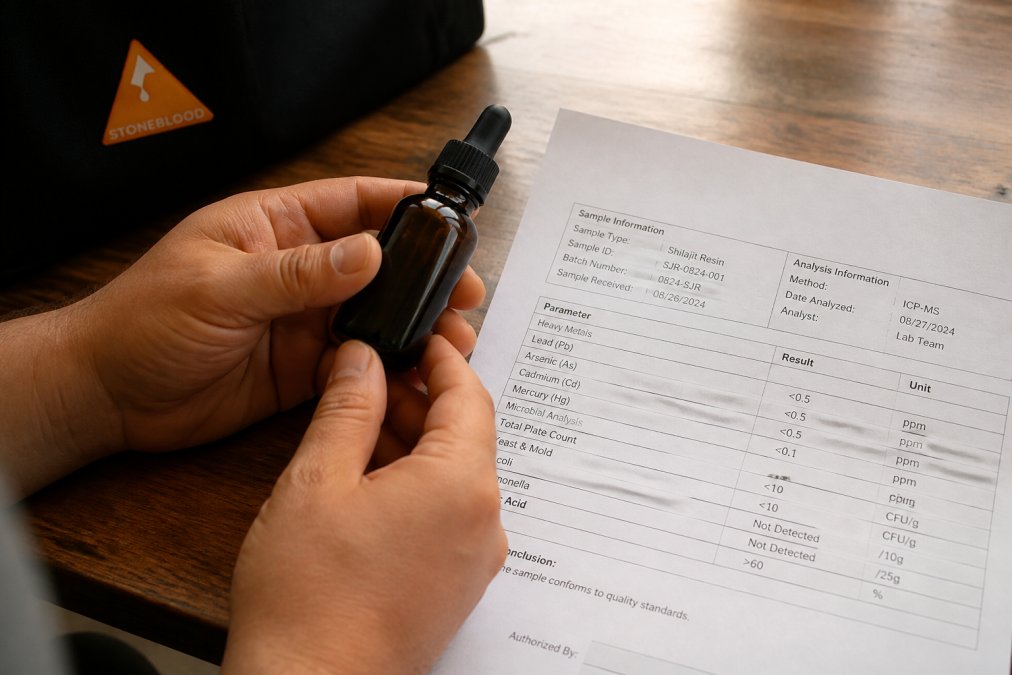
Five checks separate real resin from adulterated product:
- Solubility: Real resin dissolves cleanly in warm water or coffee. Fakes leave grit or float.
- Texture: It should be pliable, not rock-hard or runny at room temperature.
- Lot code: Every bottle should carry a batch number and best-by date you can trace.
- Certificate of analysis: Issued per lot, not a generic PDF recycled across products.
- Origin disclosure: A named source region beats a vague "Himalayan" claim.
Reading a Certificate of Analysis Like a Buyer, Not a Chemist
You don't need a chemistry degree. You need three things: the lab's name and accreditation, the test date, and the actual numbers for heavy metals and microbials. Look for an ISO/IEC 17025 certified lab, since that accreditation means the lab itself gets audited. Then check that the report matches your lot number. A certificate with no lot, no date, or no lab name is decoration, not documentation.
Shilajit Benefits and Side Effects: What the Evidence Supports
Shilajit is traditionally used in Ayurveda as a Rasayana, a class of preparations associated with longevity and vitality. Modern users most often report energy, focus, and recovery support. Many practitioners call it an adaptogen, used to help the body handle stress rather than force stimulation the way caffeine does.
Side Effects: What to Actually Watch For
Shilajit is generally well tolerated at standard doses. Common complaints are mild: stomach upset, loose stools, or a slight headache when starting, usually resolving within a few days. Some users feel overstimulated if they take it late in the day, which is why most practitioners suggest morning dosing.
Drug Interactions and Who Should Skip It
Shilajit is not known to have severe interactions, but the caution list is real:
- Blood thinners and antiplatelet drugs: Fulvic acid may have mild anti-coagulant activity. If you take warfarin, apixaban, rivaroxaban, or daily aspirin, talk to your prescriber first.
- Blood pressure and diabetes medications: Shilajit may modestly affect blood pressure and blood sugar. If you're medicated for either, monitor and coordinate with your doctor.
- Iron and other mineral supplements: Because shilajit transports minerals, stacking it with high-dose mineral supplements can push intake higher than intended.
- Gout or kidney stone history: Shilajit contains uric acid precursors and minerals. If you have a history of either condition, get medical clearance before starting.
- Pregnancy and nursing: Skip it. There is no adequate safety data, and the heavy-metal risk is not worth taking.
- Autoimmune conditions and immunosuppressants: Humic substances can modulate immune activity. Coordinate with your specialist.
The Consumer Verification Checklist Competitors Don't Give You
"Is it worth the price" is really two questions: is it safe, and is it authentic. You can answer both in about ten minutes with the certificate of analysis (COA) for your specific lot:
- Match the lot number. The COA must list the same batch/lot code printed on your bottle. A generic PDF that covers "all products" is not a COA, it's marketing.
- Confirm the lab name and accreditation. Look for an ISO/IEC 17025 accredited laboratory. That accreditation means the lab itself is audited against international testing standards, not just self-certified.
- Check the test date. It should be recent and tied to your production run, not a two-year-old report recycled across new batches.
- Read the heavy-metal numbers, not just the pass/fail. You want actual values for lead, arsenic, cadmium, and mercury in parts per million (ppm), with results at or below the limits set by state and federal regulators. "Passed" without numbers tells you nothing.
- Confirm microbial panels. Look for negative results on Salmonella, E. coli, Staphylococcus aureus, and Pseudomonas aeruginosa.
- Verify the source region. A named region (e.g., a specific mountain range or state) beats a vague "Himalayan" claim, because a named source is a claim you can hold a seller to.
- Cross-check the seller's identity. If the brand, the lab, and the bottling facility are all unnamed, you have no chain of custody to verify.
Shilajit Dosage and Usage Guide: How Far a Bottle Really Goes
Standard dosage is one dropper full, about 10-15 drops, taken once daily. Mix it into water, coffee, tea, or food, or hold it under your tongue. That single daily serving is what makes the per-day math work.
Heavy Metals, Microbial Contamination, and the Testing That Matters
Heavy metal and microbial testing is the single most important quality signal for any shilajit product. Lead, arsenic, cadmium, and mercury occur naturally in soil and rock, and resin pulled from the earth can concentrate them if the source or purification process is sloppy.

Geographic Sourcing and Long-Term Value: Why Origin Changes the Math
Origin changes the math because it changes three things at once: the mineral profile, the supply chain length, and the price you pay. Most reviews treat "Himalayan" as a single category. It isn't.
How Geography Affects Mineral Composition
Shilajit is an exudate from rock, so its composition reflects the geology it came from. Resin from high-altitude, mineral-rich mountain ranges tends to show a broader trace-mineral profile, iron, zinc, magnesium, and dozens of others, because the parent rock is more geologically diverse. Resin from lower, more uniform formations tends to be narrower. "Where it came from" is a proxy for "what's in it," and a seller who won't name the source region is asking you to take the mineral profile on faith.
How Geography Affects Price
The price difference between a $20 jar and a $60 jar is rarely the resin itself, it's the supply chain. Every handoff between harvester, refiner, exporter, importer, and repackager adds cost and risk. A long chain with offshore repackaging is cheaper to run but harder to verify, and the savings usually come from dilution, fillers, or skipped testing.
Long-Term vs. Short-Term Value
Short-term value is what you feel in the first week. Long-term value is whether the product is clean and effective enough to keep taking for months without worrying about cumulative heavy-metal exposure. A $1-a-day resin that fails a lead screen isn't cheap, it's expensive in a currency you can't refund. A $2-a-day resin with a batch-specific COA is cheaper over any meaningful time horizon.
What a Shorter Chain Looks Like in Practice
Stoneblood resin is wildcrafted in the Rocky Mountains of Utah and refined in distilled Rocky Mountain spring water, hand-harvested by one person. That single-person chain of custody means no unknown additives, no offshore repackaging, no question about who touched the product. It's bottled at a cGMP-certified facility in Lindon, Utah, certified by the Utah Department of Agriculture and Food.
Verdict: Who Should Pay for Raw Shilajit Resin (and Who Shouldn't)
Buy raw shilajit resin if you want the least processed form, value a verifiable certificate of analysis, and will use it daily enough to make the per-serving cost reasonable. Athletes, martial artists, professionals fighting afternoon brain fog, and biohackers who screen for heavy metals fit that profile.
Frequently Asked Questions
How much should real shilajit resin cost?
Authentic resin pricing reflects harvest difficulty, purification, and lab testing. Stoneblood's Shilajit Original is $33.00 for a 1 fl oz (30 ml) bottle, the Double Strength Magic Brown is $63.00, and a 3-bottle pack is $87.00. At roughly 10-15 drops daily, one bottle lasts about a month. Anything dramatically cheaper usually signals filler, dilution, or untested raw material.
How can I tell if shilajit resin is real or fake?
Real resin is dark, tar-like, and has a bitter, earthy taste; sweet or mild products often contain additives. Ask for a lot number and a batch-specific certificate of analysis. Stoneblood prints a lot number on every bottle and shares per-lot results on request, with heavy metals run by ICP-MS and microbial screening showing Salmonella, E. coli, Staphylococcus aureus, and Pseudomonas aeruginosa negative.
What are the signs of high-quality shilajit resin?
Look for documented testing, traceable sourcing, and honest labeling. Stoneblood's batches are bottled at a cGMP-certified facility in Lindon, Utah, tested by an ISO/IEC 17025 accredited lab, and show arsenic at 0.553 ppm, lead at 0.050 ppm, cadmium at 0.001 ppm, and mercury below 0.001 ppm. Water solubility and a robust earthy flavor are also good indicators of a properly refined resin.
Does shilajit resin actually work, or is it a scam?
Shilajit has a long history in Ayurveda as a Rasayana, and its fulvic acid and humic content are the main reasons people use it for energy, focus, and recovery. That said, it is a dietary supplement, not a treatment. The real scam risk is contamination and adulteration, which is why third-party testing and a certificate of analysis matter more than marketing claims.
Are there FDA regulations for shilajit supplements?
The FDA regulates dietary supplements under a framework that puts responsibility for safety and labeling on the manufacturer, but it does not approve products before they reach the market. That means independent third-party testing is your main quality check. Stoneblood uses an ISO/IEC 17025 accredited lab and publishes batch results, which gives buyers verifiable data rather than a claim on a label.
The challenge with shilajit isn't finding a jar, it's finding one you can trust. Stoneblood Shilajit solves that with hand-harvested Rocky Mountain resin, third-party testing on every batch, and cGMP-certified bottling you can trace by lot number. If you're ready to stop guessing about purity, get started with Stoneblood Shilajit and taste what a verified resin actually delivers.