
How Many Minerals Does Shilajit Have? 85+ Explained

Table of Contents
- What Is Shilajit and Where Do Its Minerals Come From?
- So How Many Minerals Does Shilajit Have? The 85+ Claim Examined
- Fulvic Acid Benefits for Energy and Recovery
- Why Mineral Count Alone Doesn't Tell the Whole Story
- How to Identify High-Quality Shilajit Resin
- Shilajit Dosage and Safety Guidelines
- Frequently Asked Questions
Last Updated: September 20, 2026
What Is Shilajit and Where Do Its Minerals Come From?
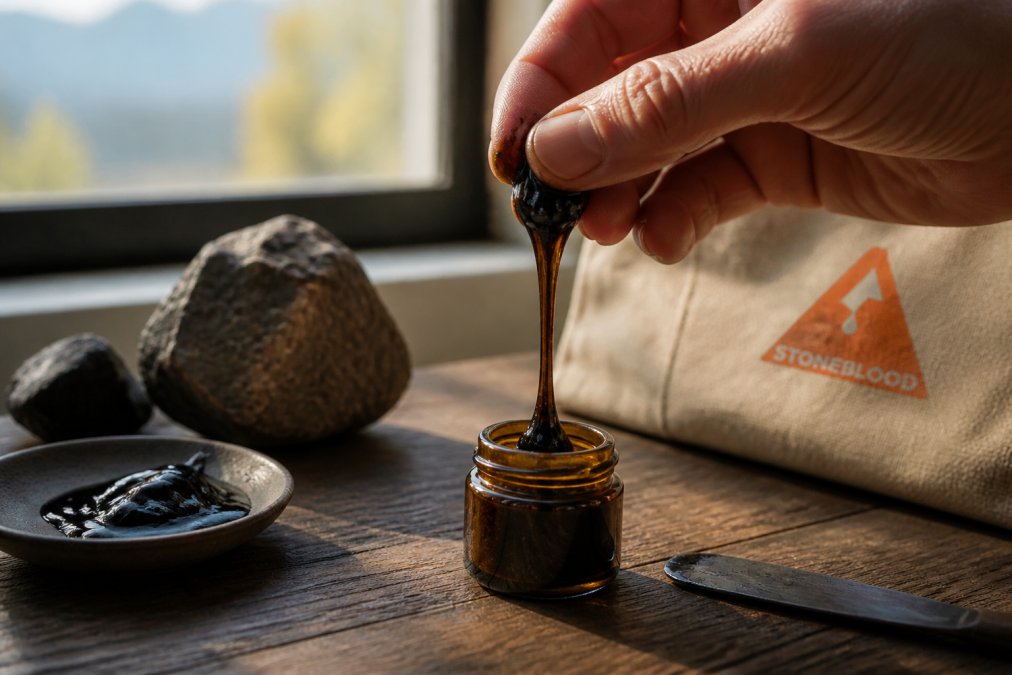
Shilajit is a dense, tar-like resin that seeps from rock crevices in high mountain ranges, formed over centuries as plant matter and humic material decompose under pressure. This guide from Stoneblood Shilajit examines what that resin actually contains, and why the mineral count matters far less than how those minerals behave in your body.

The short answer to how many minerals does shilajit have is that most traditional sources cite 85 or more. That number gets repeated everywhere, but few brands explain where it comes from or what it means for your cells. Below, we break down the mineral profile, the role of fulvic acid, and the contamination risks that separate a real resin from a marketing claim.
How Shilajit Forms in High-Altitude Rock
The process is geological, not botanical. Over millions of years, compressed plant material and humus break down into a nutrient-dense organic-mineral complex that slowly exudes from rock faces during warmer months.
Harvesters in the Rocky Mountains and the Himalayan range collect this exudate by hand. The altitude matters: slower decomposition at high elevation preserves a broader spread of trace elements in the mineral matrix. According to the National Center for Complementary and Integrative Health's overview of Ayurvedic substances, traditional preparations like shilajit require careful sourcing because composition varies widely by region and method.
So How Many Minerals Does Shilajit Have? The 85+ Claim Examined
The 85+ figure refers to the total count of minerals and trace elements identified in shilajit resin, not 85 separate active ingredients. Most analyses group them into two categories: essential minerals your body needs in larger amounts, and trace elements required in microgram quantities.
That distinction matters. A resin can technically contain 85 elements and still deliver very little of the ones you actually need, because quantity in the bottle says nothing about absorption. This is the gap most guides skip.
Where the 85+ Number Actually Comes From
The number is not a fixed constant. It is an estimate drawn from laboratory element scans, and it moves depending on three things: the source rock, the harvest season, and the analytical method used.
Most labs run one of two tests. An ash assay burns off the organic matrix and weighs what remains, which tells you total mineral mass but not which elements are present. An ICP-MS scan (inductively coupled plasma mass spectrometry) ionizes the sample and identifies individual elements down to parts-per-billion levels. The same resin can read as "70+ minerals" on one panel and "85+" on another simply because the second lab looked for more elements at lower detection limits.
That is why "85" should be read as a ceiling on what has been detected, not a guaranteed floor in every jar. A batch from a different mountain face, a wetter season, or a shallower seam will produce a different element list.
Essential Minerals and Trace Elements Found in Shilajit
The mineral profile typically includes:
- Macrominerals: magnesium, potassium, calcium
- Trace elements: zinc, iron, selenium, manganese, copper
- Rarer elements: lanthanum and other elements present in minute concentrations
Magnesium and potassium support metabolic function and cellular energy. Zinc and selenium contribute to antioxidant properties and immune signaling. Iron supports oxygen transport. None of these work in isolation, which is why the organic-mineral complex matters more than any single element.
Standardization vs. Natural Variation: Why No Two Batches Match
Wildcrafted resin is not a manufactured compound. There is no recipe that produces a consistent 85-element profile batch after batch, and any brand claiming otherwise is describing marketing, not geology.
What a responsible producer does instead is test every lot and publish the result. A certificate of analysis for a specific lot number will typically show:
- Total mineral content by weight
- Fulvic acid and humic acid percentages
- Heavy metal results (lead, arsenic, cadmium, mercury) against established limits
- Microbial panel results
When you compare two certificates side by side, you will often see the mineral count differ by 10 to 20 elements while the fulvic acid percentage stays in a similar range.
Fulvic Acid Benefits for Energy and Recovery
A common mistake is buying shilajit based on the mineral claim alone and ignoring fulvic acid concentration. In practice, a resin with a slightly lower mineral count but strong fulvic acid activity will outperform a higher-count product that sits in your gut unabsorbed.
Shilajit Original — Stoneblood →
Why Mineral Count Alone Doesn't Tell the Whole Story
Two resins can both list 85+ minerals and behave completely differently in your body. The variables that actually determine value are bioavailability, batch consistency, and how the resin was purified.
Bioavailability: Getting Minerals Into Cells, Not Just Into the Bottle
Bioavailability describes how much of a nutrient your body can actually absorb and use. Ionic minerals in a fulvic acid matrix are far more available than mineral salts in a compressed tablet.
Standardization vs. Natural Variation Between Batches
Wildcrafted resin is not a manufactured compound, so no two batches are chemically identical. That is normal, but it makes lot-level testing essential rather than optional.
How to Identify High-Quality Shilajit Resin
Knowing how to identify high-quality shilajit resin comes down to documentation, not packaging. Purity standards are proven on paper, and any serious producer should hand it over without hesitation.
Run every product through this checklist before buying:
- Does the label show a lot number and best-by date?
- Will the brand share a certificate of analysis for your specific batch?
- Is heavy metal testing done by an accredited third-party lab?
- Is the resin additive-free, with no fillers or flow agents?
- Is the source disclosed, or is it vague about origin?
| Checkpoint | Weak Signal | Strong Signal |
|---|---|---|
| Testing | "Lab tested" claim only | Lot-specific certificate of analysis |
| Sourcing | Undisclosed origin | Named region and harvest method |
| Purity | Proprietary blend | Single-ingredient resin, no additives |
| Traceability | No lot number | Lot-coded bottle with best-by date |
Shilajit Dosage and Safety Guidelines
Standard shilajit dosage and safety guidelines call for a small daily amount, typically one dropper of resin mixed into water, coffee, or tea. Starting low and adjusting after a week or two is the sensible approach.
Why Heavy Metals Are the Real Safety Question
Shilajit is a rock exudate. The same geological process that concentrates beneficial trace elements like zinc, selenium, and magnesium also concentrates whatever else is in the source rock, and that can include lead, arsenic, cadmium, and mercury.
What to Look For on a Certificate of Analysis
A meaningful heavy metal panel is not a single "passed" stamp. It is a table. Look for:
- Lead, arsenic, cadmium, mercury listed individually with measured values, not grouped
- The testing laboratory's name and accreditation, so you can verify it independently
- The lot number, matching the bottle in your hand
- Detection limits, so you can see how low the lab could actually measure
Fulvic Acid and Mineral Absorption
Fulvic acid does more than carry minerals. It chelates them, binding to metal ions and holding them in a form the body can absorb. This is the same mechanism that makes the mineral content useful, and it is also why the fulvic acid fraction matters for safety: a resin with strong fulvic acid activity and a clean heavy metal panel is doing two things at once.
Who Should Be Cautious
If you take prescription medication, are pregnant, or manage a chronic condition, talk to your physician before starting. Shilajit is not intended to diagnose, treat, cure, or prevent any disease, and it is not a substitute for a balanced diet. Anyone with a history of kidney or liver conditions should be especially careful, since those organs process mineral load.
Frequently Asked Questions
Does shilajit actually contain 85 minerals?
The 85+ figure is a commonly cited count drawn from traditional Ayurvedic texts and modern elemental analysis of shilajit resin. Full-spectrum analysis identifies major minerals like magnesium, potassium, calcium, iron and zinc alongside trace elements such as selenium, manganese, copper and lanthanum. The exact number varies by source location and batch, so treat 85 as a benchmark rather than a fixed guarantee. What matters more is whether the product publishes third-party test results confirming its mineral content and purity.
Are all shilajit products consistent in their mineral count?
No. Mineral content in shilajit varies with the geological formation it comes from, the altitude, the plant material compressed into it, and how it is refined. Himalayan resin and North American resin can differ in their elemental composition. Some brands also dilute resin with fillers, which lowers the mineral density per serving. Look for a lot number and a certificate of analysis so you can confirm what is actually in the bottle you bought.
What is the role of fulvic acid in mineral absorption?
Fulvic acid acts as a transporter. Its molecular structure binds to minerals and helps carry them through cell walls, which is why shilajit minerals are described as bioavailable rather than simply present. Without that transport mechanism, minerals can pass through digestion largely unused. This is the core argument for taking shilajit instead of a standard mineral tablet: the fulvic acid content supports how well the minerals are absorbed and used by the body.
How much shilajit should I take, and is it safe daily?
A common starting point is one dropper, roughly 10 to 15 drops, taken once daily, mixed into water, coffee, tea or food, or held sublingually. Start at the lower end for the first week to see how you respond. Daily use is typical in traditional practice, but check with your doctor first if you are pregnant, nursing, taking medication, or managing a health condition. Buy from a brand that publishes heavy metal testing for each batch.