
Natural Alternatives to Synthetic Mineral Supplements

Table of Contents
- Natural Mineral Supplements vs. Synthetic: What Actually Differs
- Food Sources of Essential Minerals (And Where They Fall Short)
- Mineral Supplement Absorption: Why Form Matters More Than Milligrams
- Mineral Supplement Label Guide: Seven Lines Worth Reading
- Raw Mineral Resin vs. Synthetic Energy Supplements
- Stoneblood Shilajit: A Liquid Mineral Resin in Practice
- Purity, Testing, and What to Ask Before You Buy
- Conclusion
- Frequently Asked Questions
Last Updated: October 14, 2026
Natural Mineral Supplements vs. Synthetic: What Actually Differs
Most people assume a mineral is a mineral, no matter where it comes from. The label tells a different story.
At Stoneblood Shilajit, we wildcraft a mineral-rich resin from rock in the Rocky Mountains, then refine it into water-soluble liquid drops.
The practical difference shows up in absorption. A mineral your body cannot move into a cell is a mineral you paid for and did not get.
| Feature | Natural (food-derived) | Synthetic (lab-bound) |
|---|---|---|
| Source | Plants, rock, mineral resin | Mineral salts bound in a lab |
| Common forms | Fulvic-acid complexes, ionic minerals | Carbonate, oxide, sulfate |
| Cofactors included | Often present | Usually absent |
| Label transparency | Varies widely | Varies widely |
| Cost | Usually higher | Usually lower |
How to Tell Which One You Are Holding
Read the ingredient list, not the front label. Synthetic forms usually name a salt: magnesium oxide, zinc sulfate, calcium carbonate. Natural forms name a source: shilajit, seaweed, humic and fulvic complexes, or a specific plant.
One detail separates the two faster than anything else. Synthetic minerals are almost always standardized to a milligram number. Natural mineral sources rarely are, because their content varies by batch and origin.
Food Sources of Essential Minerals (And Where They Fall Short)
Whole foods remain the best starting point for minerals, and the reason is not sentiment. It is structure. In a leaf of spinach or a handful of pumpkin seeds, minerals arrive attached to organic acids, amino acids, and other compounds the gut already knows how to handle.
Here is where the major minerals actually live in a typical diet:
| Mineral | Common food sources | Notes on form |
|---|---|---|
| Magnesium | Leafy greens, pumpkin seeds, almonds, black beans, oats | Bound to chlorophyll and phytate in plants |
| Calcium | Dairy, fortified plant milks, sardines with bones, bok choy, tahini | Varies widely by source; dairy is well studied |
| Zinc | Oysters, beef, pumpkin seeds, chickpeas, cashews | Animal sources tend to be more readily absorbed |
| Iron | Lentils, spinach, red meat, fortified cereals | Heme iron from meat absorbs differently than non-heme from plants |
| Potassium | Potatoes, bananas, beans, yogurt, avocado | Widely available in whole foods |
| Selenium | Brazil nuts, tuna, eggs, sunflower seeds | A single Brazil nut can carry a meaningful share of daily needs |
Two practical patterns are worth knowing. First, plant minerals often come with absorption blockers. Phytates in grains and legumes, and oxalates in spinach and rhubarb, bind minerals and reduce how much you actually take in.
What Soil Depletion Changed
Crops grown in soil that has been farmed hard for decades tend to carry fewer minerals than the same crops grown generations ago. The plant still grows. It just has less to draw from.
That is the honest case for supplementing at all. It is also why the form of what you supplement with matters more than the number on the front of the bottle.
Mineral Supplement Absorption: Why Form Matters More Than Milligrams
A 500 mg label claim means nothing if the mineral never leaves your gut. Absorption is the only number that counts, and it is almost never printed.
Minerals need help crossing into cells. Fulvic acid acts as a carrier, binding minerals and moving them through cell walls. This is why we refine our shilajit into a water-soluble liquid: the minerals arrive in a form the body can work with.
Mineral Supplement Label Guide: Seven Lines Worth Reading
Most supplement labels are designed to be skimmed. Read these seven lines instead, in this order:
- Serving size, how much the numbers actually describe
- Mineral form, salt, oxide, or food-derived complex
- Source, where the raw material came from
If a label will not tell you who tested the batch, that is your answer.
Raw Mineral Resin vs. Synthetic Energy Supplements
This is the comparison most guides skip. A raw mineral resin and a synthetic energy supplement are solving two different problems, and the difference shows up in mechanism, timing, evidence quality, and safety profile.
Defining the two categories clearly
A natural mineral source is a whole-material product. Shilajit is the clearest example: a thick, tar-like substance that seeps from rock in high mountain ranges, formed over long periods from compressed plant material and mineral deposits.
A synthetic energy supplement is usually a blend of isolated ingredients.
Neither category is automatically better. They are simply not the same product, and the label rarely explains the difference.
Onset, duration, and the shape of the effect
| Raw Mineral Resin | Synthetic Energy Supplement | |
|---|---|---|
| Onset | Gradual, often noticed over days of consistent use | Fast, often within 30 to 60 minutes |
| Duration | Sustained background support | Short window, commonly 3 to 6 hours |
| Mechanism | Minerals plus fulvic acid as a carrier complex | Stimulant-driven, often with a secondary amino acid or vitamin blend |
| Rebound | Uncommon; effect tapers quietly | Common; a drop-off or crash is frequently reported |
| Best for | Steady daily support | A short, focused push |
A common pattern is that people who rely on stimulant-based products notice a sharp lift followed by a dip, and they take another serving to compensate. A natural mineral source does not work that way. It supplies material the body can use over time, and the support builds quietly rather than arriving all at once.
Shilajit Original — Stoneblood →
Evidence quality: what is actually established
This is where most comparisons get vague, so it is worth being specific.
- Caffeine is one of the most studied ingredients in the category. Human trials consistently show improved alertness and reaction time at typical doses, with tolerance developing over regular use.
- Green tea extract and its catechin content has a body of human research on alertness and metabolic markers, though results vary by dose and preparation.
- Ginseng has a long traditional history and a mixed but real body of human studies, with effects that are generally modest and not always reproducible.
The honest summary is that stimulant ingredients have the strongest short-term evidence for a felt effect, while whole-material mineral sources rest more on traditional use and emerging research. Both can be reasonable choices for different goals.
Safety, interactions, and when to check with a clinician
This is the part competitors tend to skip entirely, and it matters more than the marketing.
- Stimulant sensitivity. Caffeine and stimulant blends can affect sleep, heart rate, and mood in sensitive people. If you are sensitive to stimulants, or you drink coffee or energy drinks alongside a supplement, you may be stacking more than you realize.
- Medication interactions. Some supplements can interact with prescription medications, including blood thinners, thyroid medications, and certain antidepressants. This is a conversation for a clinician, not a label.
- Health conditions. If you are pregnant, nursing, managing a health condition, or taking any medication, talk to a healthcare professional before starting any supplement.
- Mineral source products. Because mineral resins come from the ground, contaminant screening matters. A reputable supplier tests every batch through an independent lab and can show you the results.
How to choose between them
If you want a fast spike for a short window, a stimulant-based product delivers that, with the trade-offs above. If you want steady daily support from a whole-material source, a natural mineral source is the better fit. Choose by the shape of the effect you need and by how much you value transparency about sourcing and testing, not by the label claim.
Stoneblood Shilajit: A Liquid Mineral Resin in Practice
Raw shilajit oozes from rock as a thick, tar-like resin. Ours is wildcrafted from rock in the Rocky Mountains, then refined in distilled spring water into a water-soluble liquid you can actually take.
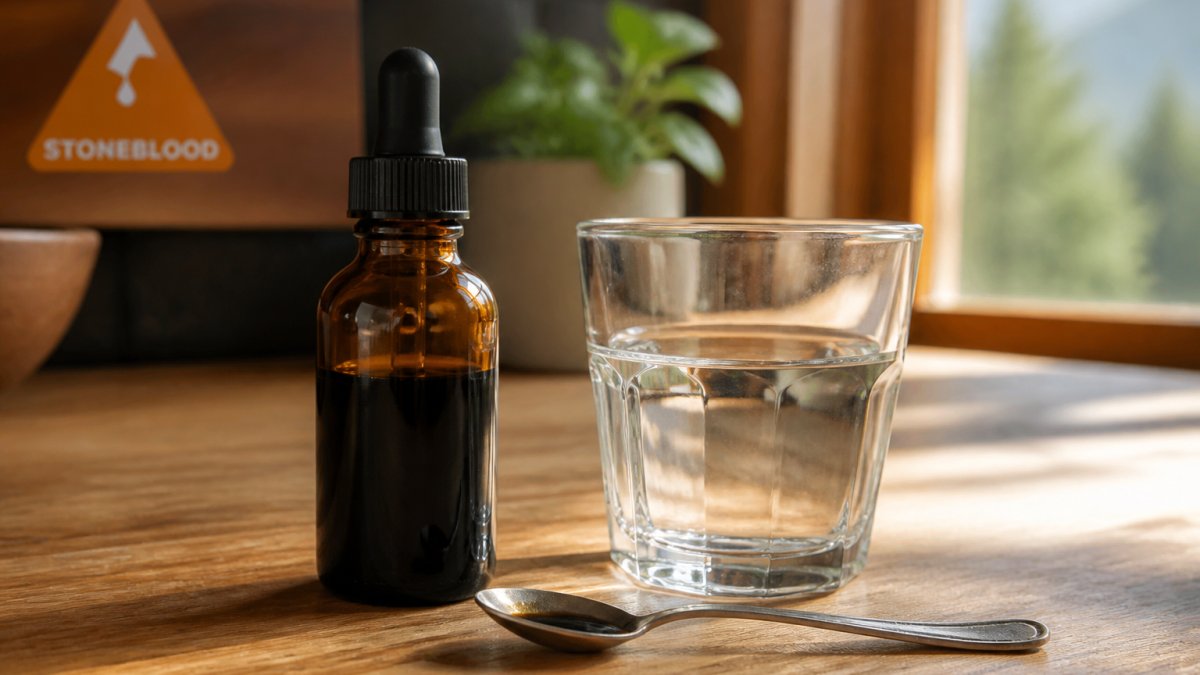
That refinement is the point. Liquid drops dissolve cleanly in water, coffee, tea, or food. Our flagship is Magic Brown, a double-strength liquid shilajit.

Shilajit has a long history of traditional use in Ayurveda as a Rasayana, and it carries fulvic acid and a broad spread of trace minerals. You can read the testing details on our quality and safety page.
Purity, Testing, and What to Ask Before You Buy
Heavy metals are the real risk in any mineral product, natural or synthetic. Minerals come from the ground, and so do contaminants. Testing is what separates a clean batch from a gamble.
Ask any supplier four questions before you buy:
- Which independent lab tested the batch?
- What did they screen for, specifically?
- Can you see the certificate of analysis for your lot?
- Is the batch code printed on the bottle?
A supplier who cannot answer all four is asking you to take their word for it. We publish our testing and match every bottle to a lot number, so you can check the batch you actually hold.
Conclusion
Sorting real mineral sources from synthetic ones comes down to reading the form, the source, and the test results rather than the front of the bottle. That is a slower way to shop, and a better one.
Stoneblood Shilajit makes that choice straightforward. Start with Magic Brown for double strength, or the Original 3-Bottle Pack if you want a steady supply on hand.

Frequently Asked Questions
What are natural alternatives to synthetic mineral supplements?
The main options are mineral-rich whole foods, food-derived or whole-food mineral powders, and naturally occurring mineral substances such as shilajit. Each delivers minerals in a different form, so absorption varies. Foods provide minerals alongside other nutrients, while naturally occurring substances like shilajit supply minerals in ionic form along with fulvic acid. Many people combine a food-first approach with one concentrated natural mineral source rather than relying on isolated synthetic salts.
Can you get enough minerals from food alone?
It is possible in theory, but harder in practice. Modern farming has depleted many soils, so the same vegetables grown decades ago may carry fewer minerals today. A diet built on varied, minimally processed foods still helps, and growing your own in mineral-rich soil is one way to close the gap. For most people, food remains the foundation and a natural mineral supplement fills in what diet does not cover.
Which foods are naturally rich in essential minerals?
Leafy greens, root vegetables, legumes, nuts, seeds, and whole grains are common sources. Sea vegetables and mineral-rich spring water add trace elements that are harder to get elsewhere. Dark leafy greens such as kale and spinach supply magnesium and calcium, pumpkin seeds are high in magnesium and zinc, and beans cover iron and potassium. Eating a rotating mix of these foods gives broader mineral coverage than leaning on one or two favorites.
Are whole-food mineral supplements better than synthetic ones?
It depends on the specific product and your goal. Whole-food and naturally derived minerals come with cofactors that may support how well they are absorbed, while synthetic salts are often cheaper and more precisely measured. Neither category is automatically superior. Read the label, check whether the mineral form is listed, and look for third-party testing. A well-tested natural mineral supplement usually beats an untested one, regardless of category.
What should you look for on a mineral supplement label?
Check the serving size, the mineral form (not just the name of the mineral), and whether the label shows elemental amounts rather than compound weights. Look for a lot number, a best-by date, and a statement that the product is third-party tested for heavy metals and microbials. Fewer fillers and no proprietary blends make a label easier to trust. If a brand will not share its test results, treat that as a warning sign.
These statements have not been evaluated by the Food and Drug Administration. This product is not intended to diagnose, treat, cure, or prevent any disease. Consult a healthcare professional before starting any supplement, especially if you are pregnant, nursing, taking medication or managing a health condition.