
How to Verify Supplement Sourcing Transparency

Table of Contents
- Why Supplement Sourcing Transparency Matters
- How to Verify Supplement Origin and Traceability
- Questions to Ask Supplement Brands
- How to Access and Review Supplement Quality and Safety Information
- Verify Claims Through Independent Sources
- Red Flags That Indicate Low Transparency
- Frequently Asked Questions
Last Updated: October 10, 2026
Why Supplement Sourcing Transparency Matters
When you buy a supplement, you're trusting the label. You're trusting the company. You're trusting that what's inside the bottle matches what's printed on it. But how do you actually know if that trust is warranted? Learning to verify supplement sourcing is the answer.
Supplement sourcing transparency, the ability to trace ingredients back to their origin and verify their quality, is the foundation of everything else. Without it, you're buying blind. A product might claim to be wildcrafted, pure, or third-party tested. Those claims sound good. But claims aren't proof.
At Stoneblood Shilajit, we believe transparency isn't optional. It's the only way a customer can make an informed choice. This guide walks you through the practical steps to verify where a supplement comes from, how it's made, and whether the quality claims hold up to scrutiny.
How to Verify Supplement Origin and Traceability
The first question to ask is simple: where did this come from? Not the country on the label, but the actual source. Many supplements claim to be sourced from pristine locations. Some are. Others are sourced from anywhere that's cheap, then repackaged under a brand name.
Start by asking the manufacturer directly. A transparent company will have clear answers. A vague company will give you marketing language instead of facts.
Request the Country of Origin
Know exactly where the raw material comes from. Not "the Himalayas" or "premium sources." Specific geography. Specific supplier information if possible.
A quality company tracks this information at the batch level. They can tell you which region, which harvest, which supplier provided the ingredient in your bottle. If they can't, that's a red flag.
Ask for documentation. Certificates of origin, supplier contracts, or harvest records. These should be available to you before you buy, or at least after you ask.
Ask for Supplier and Manufacturing Details
Who actually grows or produces the raw material? Who refines it? Who bottles it? These are three different steps, and each one matters.
A transparent company names their suppliers. They explain their manufacturing process. They don't hide behind phrases like "proprietary sourcing" or "trusted partners." Those phrases mean they won't tell you who they actually work with.
Ask specifically: What is the name of the supplier? What certifications do they hold? How long has your company worked with them? Can they provide a contract or audit report?
Check for Lot Traceability
Every batch of supplement should have a lot number. That number should connect to specific test results, specific sourcing information, and specific manufacturing dates.
Request the certificate of analysis for your specific lot. Not a generic one from the company website. The actual test results for the batch you bought.
A company that tracks this information has nothing to hide. They can pull up your lot number and send you the documentation within days. If they can't, the supply chain isn't transparent.
Questions to Ask Supplement Brands
Before you buy, email the company with these questions. Their answers will tell you whether they're serious about transparency.
Sourcing and Supply Chain Questions
Ask these five questions directly:
- What is the country of origin for the raw material in this product?
- What is the name of the primary supplier or producer?
- How long has your company worked with this supplier?
- Can you provide a certificate of origin or supplier audit report?
- Is your supply chain documented at the batch level, and can I access my lot's sourcing information?
Listen for specificity. "We source from trusted partners in pristine regions" is not an answer. "Our shilajit is hand-harvested by a single wildcrafted source in the Rocky Mountains of Utah, USA" is an answer.
Testing and Certification Questions
Ask about the testing process:
- What independent laboratory tests your products?
- What specific contaminants are tested for (heavy metals, microbials, pesticides)?
- Are test results available per batch or only as generic samples?
- What certifications does your facility hold (GMP, BRC, ISO)?
- Can you provide the accreditation number for your testing lab?
A company that uses a credible, accredited lab will have no problem sharing the lab's name and accreditation number. If they're vague about testing, the testing probably isn't rigorous.
How to Access and Review Supplement Quality and Safety Information
Once you have the company's answers, you need to verify supplement sourcing independently. Don't just accept what the company tells you. Verify it yourself.
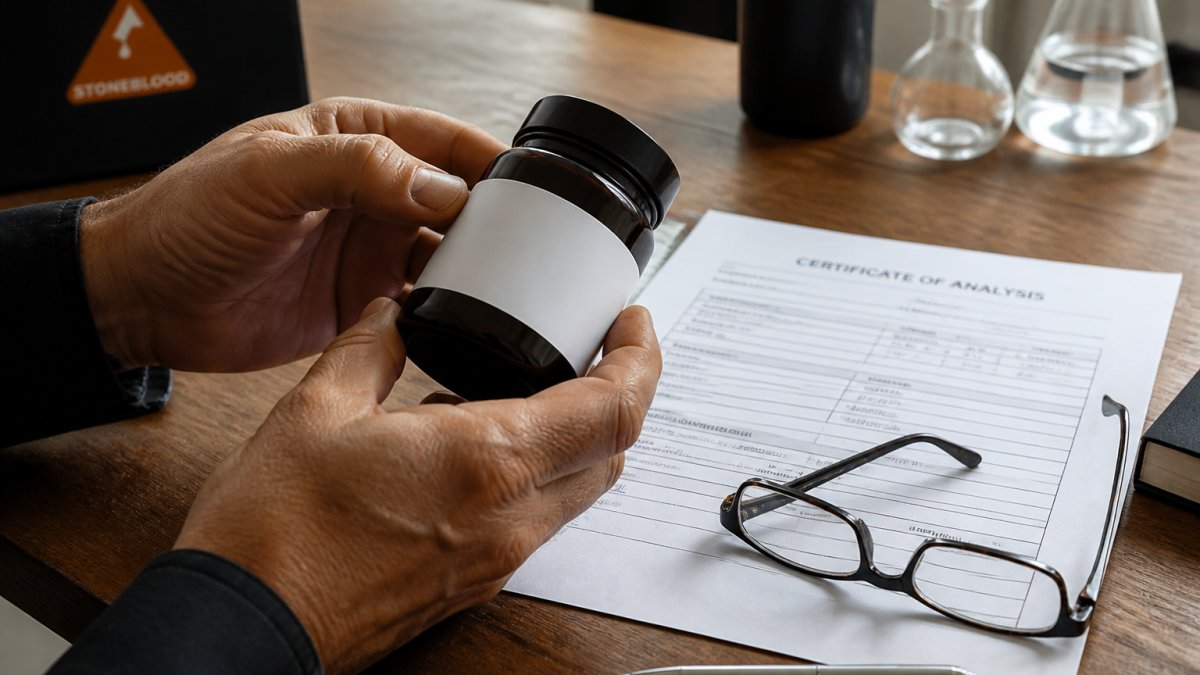
Request and Interpret the Certificate of Analysis
A certificate of analysis (CoA) is a document from an independent laboratory that lists what's in the product, what's not in it, and whether contaminants are present or within acceptable limits. It is the single most important verification document you can obtain.
How to request it:
Find the lot number on your bottle. It's typically printed on the label or bottom of the container. Email the company with your lot number and ask for the certificate of analysis for that specific batch. Do not accept a generic certificate from the company website, those are often representative samples, not your actual product.
A transparent company will provide the lot-specific CoA within 3-5 business days. If they say "we don't have batch-level testing" or "test results are only available to retailers," that is a major red flag.
What to check on the certificate:
- Laboratory name and accreditation: The lab's name, address, and accreditation number should be clearly printed. Look for ISO/IEC 17025 accreditation (see below for how to verify this).
- Test date: The date the sample was tested should be close to the product's manufacture date. If the test date is months old and the product is fresh, the batch may not have been tested.
- Lot or batch number: The certificate must reference the specific lot number on your bottle. If it doesn't match, you have the wrong certificate.
- Heavy metals testing: The certificate should list results for arsenic, lead, cadmium, and mercury, each with a numerical value and a limit. For example: "Arsenic: <0.5 ppm (limit: 1.5 ppm)." The "<" symbol means the level is below the detection limit, which is ideal. Any result above the limit is unacceptable.
- Microbial testing: Look for tests on E. coli, Salmonella, total aerobic microbial count, and mold/yeast. Results should show "Not Detected" or "ND" for pathogens, and numerical counts below acceptable thresholds for environmental microbes.
- Potency or identity testing: If the product claims a specific active ingredient or mineral content, the certificate should confirm it. For shilajit, this might include fulvic acid content or mineral profile.
- Lab signature or certification mark: A legitimate certificate will have an official lab signature, seal, or digital verification code. Unsigned or unsigned certificates are not valid.
Understand Raw-Material Testing vs. Finished-Product Testing
Many companies test their raw ingredients but not the final product. This is a critical distinction.
Raw-material testing confirms that the ingredient (e.g., shilajit resin before refinement) meets quality standards when it arrives at the facility. This is important but incomplete, it doesn't account for contamination that might occur during processing, bottling, or storage.
Finished-product testing confirms that the product in your bottle meets standards. This is what you should prioritize. Ask the company: "Is this a test of the raw material or the finished product in the bottle?" If they can't answer clearly, or if they only test raw materials, the supply chain has a gap.
For liquid shilajit drops like Magic Brown Liquid Shilajit Drops (Double Strength) or Shilajit Original Liquid Drops, finished-product testing is especially important because the refinement process (converting raw resin into a water-soluble liquid) introduces new handling steps where contamination could occur.


Verify Laboratory Accreditation Independently
Don't just trust the company's claim that their lab is "third-party tested" or "accredited." Verify it yourself.
ISO/IEC 17025 accreditation is the gold standard for supplement testing labs in the United States. It means the lab has been audited by an independent accrediting body and meets strict standards for equipment, personnel, procedures, and quality control.
To verify accreditation:
- Note the lab's name and accreditation number from the certificate of analysis.
- Visit the PJLA (Professional Laboratory Accreditation) database. PJLA is the primary accreditor for supplement labs in the United States.
- Search for the lab by name or accreditation number. If it appears in the database with an active status, the accreditation is real.
- Check the scope of accreditation. The lab should be accredited specifically for testing dietary supplements or food products, not just general chemistry. A lab accredited only for water testing, for example, may not be qualified for supplement analysis.
If the lab does not appear in the PJLA database, ask the company which accrediting body issued the accreditation and request documentation. Be skeptical of labs claiming accreditation from organizations you cannot verify.
Understand Chain of Custody and Sampling Protocols
A certificate of analysis is only as reliable as the sample it represents. If the sample wasn't properly collected, stored, or transported, the results don't reflect your product.
Ask the company:
Shilajit Original — Stoneblood →
- Who collected the sample? Was it the manufacturer, a third-party auditor, or the lab itself? Ideally, the lab or an independent auditor collects the sample to prevent tampering.
- How was the sample stored and transported? Was it sealed, refrigerated if needed, and tracked from the facility to the lab? This is called chain of custody.
- How large was the sample? A tiny sample may not represent an entire batch. Ask if the sampling protocol follows FDA guidelines for supplement sampling.
A company with rigorous testing will have documented answers to these questions. Vague answers suggest the testing process is not as independent or rigorous as claimed.
GMP Certification and Manufacturing Standards
GMP stands for Good Manufacturing Practices. In the United States, dietary supplements are regulated by the FDA under the Dietary Supplement Health and Education Act (DSHEA). Manufacturers must follow GMP standards, though the FDA does not pre-approve supplements before they're sold.
Ask the company: What is the name of your manufacturing facility? Is it cGMP-certified (current GMP)? By whom?
You can verify facility certifications through:
- State health departments: Many states maintain registries of certified supplement facilities.
- The certifying body directly: If the company names a certifier (e.g., NSF, UL, or a state agency), contact them to confirm the facility's status.
- FDA inspection records: The FDA publishes inspection reports for some facilities. Search the FDA's CDER database for the facility name.
A cGMP-certified facility has been audited and meets documented quality standards for equipment, personnel, record-keeping, and contamination control. It's not a guarantee of quality, but it's a baseline. A facility with no certification is a red flag.
Verify Claims Through Independent Sources
Don't stop at what the company tells you. A transparent company will welcome independent verification. Here's how to confirm their claims systematically.
Create a Verification Checklist
Before you buy, use this checklist to evaluate a supplement brand's transparency. Score each item as "Yes," "Partial," or "No." Products scoring mostly "Yes" are safer bets.
Sourcing & Origin:
- Company names the specific country or region of origin (not just "premium sources" or "pristine regions")
- Company names the primary supplier or producer by name
- Company provides a certificate of origin or supplier audit report upon request
- Company can trace the product to a specific batch or lot number
- Company discloses any intermediaries (brokers, processors) between raw material and finished product
Testing & Quality:
- Company provides a lot-specific certificate of analysis (not just a generic sample)
- The testing lab is ISO/IEC 17025 accredited and verifiable in the PJLA database
- Heavy metals (arsenic, lead, cadmium, mercury) are tested and results are provided
- Microbial contaminants (E. coli, Salmonella, mold, yeast) are tested and results are provided
- The manufacturing facility is cGMP-certified and the certification is verifiable
Transparency & Communication:
- Company responds to sourcing and testing questions within 5 business days
- Company provides specific answers, not marketing language ("trusted partners" or "proprietary blend" are red flags)
- Company's answers are consistent across multiple inquiries
- Company publishes a transparency or quality statement on their website
Red Flags:
- Company refuses to name suppliers or manufacturing facility
- Test results are "available upon request" only after purchase
- Lot numbers are not printed on the bottle
- Facility or lab accreditation cannot be independently verified
- Pricing is significantly lower than competitors without explanation
If a product scores "No" on more than three items, especially in the Testing & Quality section, move on.
Verify Certifications Directly
For ISO/IEC 17025 accreditation (testing lab):
- Get the lab name and accreditation number from the certificate of analysis.
- Visit pjla.org and search the database.
- Confirm the lab appears with an "Active" status and that the scope includes dietary supplements or food testing.
- If the lab is not in the PJLA database, ask the company which accrediting body issued the accreditation and request a copy of the accreditation certificate.
For cGMP facility certification (manufacturing):
- Get the facility name and location from the company.
- Contact your state's health department or pharmacy board to ask if the facility is registered or certified.
- Search the FDA's CDER database for inspection records.
- If the company claims a specific certifier (e.g., NSF, UL), contact that organization directly to confirm the facility's status.
A company that can provide this information quickly and accurately is demonstrating genuine transparency.
Cross-Check Origin Claims
If a company claims their ingredient comes from a specific region, verify that region is actually known for producing that ingredient.
For shilajit specifically:
Shilajit is traditionally sourced from high-altitude mountain regions. Authentic shilajit comes from the Himalayas (primarily India and Nepal), the Andes, and other high-altitude ranges. If a company claims to source shilajit from a region not known for it, or provides vague geographic information, ask for more detail. Legitimate wildcrafted shilajit sourcing is documented and traceable.
For other supplements, research whether the claimed origin is plausible. Ginseng from Korea, turmeric from India, and ashwagandha from India are well-established sourcing regions. If a company claims to source an ingredient from an unusual region, ask why and request documentation.
Search for Independent Reviews and Complaints
Search for the company name plus "reviews," "complaints," or "third-party testing" on independent forums and review sites. Look for patterns:
- One complaint might be unfair or an isolated incident.
- Multiple complaints about the same issue (e.g., "company won't provide test results" or "lot numbers don't match certificates") suggest a real problem.
- Praise for transparency (e.g., "they responded quickly with detailed sourcing info") is a positive signal.
Be cautious of reviews on the company's own website, these are curated. Look for third-party review platforms, Reddit discussions, or supplement forums where customers discuss their experiences.
Request and Review the Supplier Audit Report
A supplier audit report is a document prepared by the company (or a third-party auditor) that confirms the supplier meets quality and safety standards. It typically covers facility conditions, record-keeping, testing protocols, and certifications.
Ask the company: "Can you provide a supplier audit report or quality assurance documentation for your primary supplier?"
If they provide one, look for:
- Audit date: Is it recent (within the last 2 years)? Older audits may not reflect current conditions.
- Auditor name: Was it conducted by the company itself (less reliable) or an independent third party (more reliable)?
- Specific findings: Does the report detail facility conditions, testing equipment, personnel qualifications, and any corrective actions taken?
- Certifications mentioned: Does the supplier hold relevant certifications (ISO 9001, food safety certifications, etc.)?
A detailed, recent supplier audit report is a strong signal of transparency. A company that refuses to share one, or that only provides a generic "quality statement," is cutting corners.
Document Everything
Keep records of all correspondence with the company. Save emails, certificates of analysis, audit reports, and any other documentation. If you ever have a concern about the product, you'll have a paper trail to reference. This also helps you compare products consistently over time and spot any changes in sourcing, testing, or transparency practices.
Red Flags That Indicate Low Transparency
Some warning signs are obvious. Others are subtle. Watch for these:
- The company won't name their supplier or manufacturing facility
- Test results aren't available or are only "available upon request" after purchase
- The company uses vague language: "premium sources," "trusted partners," "proprietary blend"
- Lot numbers aren't printed on the bottle or don't correspond to test results
- The company refuses to provide sourcing documentation
- Heavy metals or microbial testing isn't mentioned at all
- The facility or lab has no verifiable accreditation
- The company's sourcing story changes when you ask follow-up questions
- Pricing is significantly lower than competitors without explanation
Transparency costs money. It takes time to track batches, maintain supplier relationships, and test products. A company charging rock-bottom prices while claiming premium sourcing is likely cutting corners somewhere.
Verifying supplement sourcing transparency takes effort. But it's the only way to know what you're actually buying. A transparent company, one that tracks its supply chain, tests every batch independently, and shares results with you, deserves your trust. Stoneblood Shilajit does exactly this. Our shilajit is hand-harvested in the Rocky Mountains, refined in Utah, bottled in a cGMP-certified facility, and tested by an ISO/IEC 17025 accredited lab. Every batch is lot-coded and traceable. Request your batch's certificate of analysis anytime by emailing us with your lot number. Start with Magic Brown Liquid Shilajit Drops (Double Strength), our double-strength formula, or choose Shilajit Original Liquid Drops for a classic option. For consistent daily use, the Shilajit Original 3-Bottle Pack offers convenience and value. Experience the clarity that comes from complete transparency.

These statements have not been evaluated by the Food and Drug Administration. This product is not intended to diagnose, treat, cure, or prevent any disease. Consult a healthcare professional before starting any supplement, especially if you are pregnant, nursing, taking medication or managing a health condition.
Frequently Asked Questions
What does supplement sourcing transparency mean?
Supplement sourcing transparency means a brand clearly discloses where ingredients come from, how they're tested, and who manufactures the product. It includes providing certificates of analysis, naming suppliers, identifying the country of origin, and sharing third-party test results. Transparent brands make this information easily available to customers, either on their website or by request. This allows you to verify that ingredients are authentic, free from contaminants, and produced under quality standards.
How can I verify where a supplement ingredient comes from?
Ask the brand directly for the country of origin and the specific supplier name. Request documentation showing the supply chain from raw material to finished product. For shilajit specifically, verify whether it's wildcrafted domestically or imported. Check if the company provides lot numbers and batch-specific information. Ask whether they conduct supplier audits and what standards suppliers must meet. Legitimate brands will provide detailed answers and supporting documentation rather than vague claims about purity.
What questions should I ask a supplement company about its suppliers?
Ask: Who supplies your raw ingredients? Are suppliers audited for quality and safety? What certifications do suppliers hold? How often are suppliers re-evaluated? Can you provide a list of suppliers or at least confirm their location? Do you conduct on-site inspections? What happens if a supplier fails quality checks? Do you have a backup supplier if one fails testing? These questions reveal whether a brand actively manages its supply chain or simply buys from whoever offers the lowest price.
How can I evaluate a supplement's quality and safety information?
Request the Certificate of Analysis (CoA) for the specific batch you're considering. The CoA should show testing for heavy metals, microbials, and potency. Verify the testing lab is accredited (ISO/IEC 17025 is the standard). Check that the brand uses a cGMP-certified facility for bottling. Ask for dates of testing and confirm results are recent. Compare what the label claims against what testing actually shows. Reputable brands make this information transparent and available by lot number, allowing you to verify quality before purchase.