
Table of Contents
- What Lab Tested Shilajit Actually Means
- How to Read a Certificate of Analysis (COA)
- Shilajit Purity Standards: What a Reputable Label Should Show
- How to Spot Fake Shilajit Before You Buy
- Why Geography and Chain of Custody Shape Test Results
- Benefits of Liquid Shilajit Drops and How Purity Affects Them
- What to Know About Long-Term Use and Contraindications
- Frequently Asked Questions
Last Updated: September 30, 2026
What Lab Tested Shilajit Actually Means
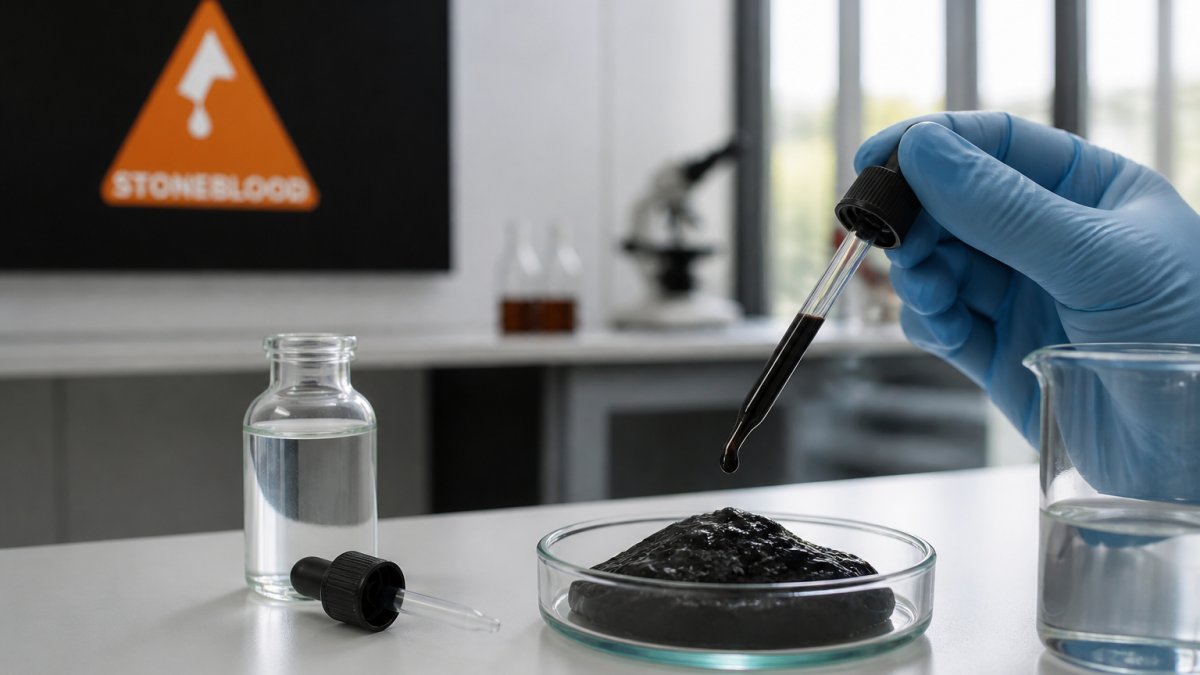
Lab tested shilajit has been sent to an independent laboratory and analyzed for identity, heavy metals, and microbial contamination before it reaches a bottle. The results are published as a Certificate of Analysis. This guide from Stoneblood Shilajit explains how to read those documents yourself.
How to Read a Certificate of Analysis (COA)
A Certificate of Analysis is a formal report from a laboratory listing what was tested, the method used, the result, and the limit that result was measured against. Without the limit column, a number tells you nothing. Read the numbers against real thresholds, so you can judge a report instead of just admiring it.
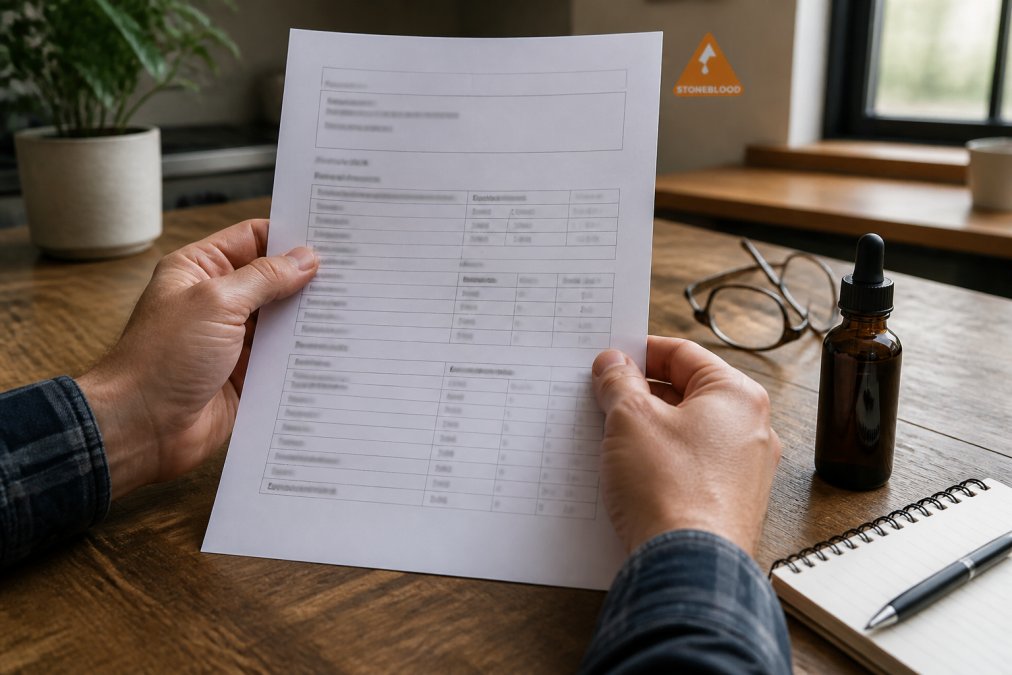
Read it in this order:
- Laboratory name and accreditation. Look for an ISO/IEC 17025 accreditation, which signals the lab has been assessed against an international testing standard. A lab without it can still run a test, but its results carry less weight.
- Lot or batch number. It must match the number printed on your bottle. A COA for a different lot proves nothing about yours.
- Test date. Recent matters more than old. A report from three years ago says nothing about the bottle in your hand.
- Method. Heavy metals are typically measured by ICP-MS (inductively coupled plasma mass spectrometry), sensitive enough to detect trace amounts at the parts-per-billion level. Microbials are usually run by culture-based plate counts or PCR.
- Result versus limit. A result below the stated limit is a pass. A result with no limit beside it is decoration.
- Units. Heavy metals are usually reported in ppm (parts per million, equivalent to mg/kg) or ppb (parts per billion, equivalent to µg/kg). Mixing up the two is the most common misreading. 1 ppm equals 1,000 ppb.
The Panels That Matter: Heavy Metals, Microbials and Identity
Three panels carry the real weight. Heavy metals cover arsenic, lead, cadmium, and mercury. Microbials cover organisms such as Salmonella, E. coli, and Staphylococcus aureus, plus total yeast, mold, and aerobic counts. Identity confirms the material is actually shilajit.
How to Judge a Heavy Metals Result Against a Real Threshold
A heavy metals number only means something when you compare it to a recognized limit. In the United States, the FDA sets action levels for lead in certain foods and dietary supplements, and California's Proposition 65 sets strict daily-exposure thresholds many supplement makers use as a de facto benchmark. For elemental impurities, the industry often references the ICH Q3D guideline, which assigns permitted daily exposures (PDEs) to each element.
A practical way to read a heavy metals panel:
- Find the limit column. Lead at 0.05 ppm against a stated limit of 0.5 ppm is a tenfold margin; 0.4 ppm against 0.5 ppm passes with almost no headroom.
- Check every element, not just lead. Arsenic, cadmium, and mercury each have their own thresholds. A report that only lists lead is not a full heavy metals panel.
- Look at the units. A result of "0.05" means nothing without ppm or ppb beside it.
- Compare across lots. Numbers across a brand's COAs should be broadly consistent. Wild swings suggest inconsistent sourcing or refining.
Red Flags on a COA
Watch for these:
- No lot number, or a lot number that does not match your bottle
- No laboratory name, or a lab with no accreditation listed
- Results with no corresponding limits
- Results with no units (ppm vs. ppb)
- A single generic COA posted for every product the brand sells
- Screenshots of reports rather than the original document
- A heavy metals panel that lists only one or two elements
Any one of these is reason to ask questions before buying.
Why Heavy Metals Testing Matters More for Shilajit Than for Most Supplements
Shilajit is a rock exudate (pubmed.ncbi.nlm.nih.gov). It seeps from layers of earth that can naturally contain arsenic, lead, cadmium, and mercury, and it concentrates minerals from those layers as it forms. That is why heavy metals testing is not optional for a serious seller.
Shilajit Purity Standards: What a Reputable Label Should Show
Shilajit purity standards come down to disclosure. A label worth trusting names the laboratory, states the lot number, and offers the report on request. It does not rely on the word "pure" alone.
- Where the shilajit was sourced and refined
- Who tested it and what accreditation that lab holds
- Whether the batch is lot-coded and traceable
- How to request the COA for your specific bottle
How to Spot Fake Shilajit Before You Buy
Fake shilajit usually reveals itself through texture, taste, and paperwork rather than any single obvious tell. Adulteration is common because raw shilajit is expensive and difficult to harvest.
Home Checks: Solubility, Taste and Texture
Raw shilajit is a thick, tar-like resin in nature. Stoneblood refines that resin into water-soluble liquid drops, which changes how it behaves in a glass.

A few practical checks:
Shilajit Original — Stoneblood →
- Solubility. Real shilajit dissolves in warm water. Liquid drops should mix cleanly into water, coffee, or tea without leaving a gritty residue.
- Taste. Authentic shilajit is bitter and earthy. A sweet or mildly flavored product has likely been cut with something.
- Texture. Resin should be sticky and pliable, not rock-hard or crumbly.
- Smell. Expect a strong, earthy, almost smoky aroma.
| Signal | What It Suggests | What To Do |
|---|---|---|
| Sweet or mild taste | Possible dilution or filler | Ask for a COA |
| Won't dissolve in warm water | Poor refinement or adulteration | Compare to a verified product |
| No lot number on bottle | No traceability | Request lot-specific results |
| COA with no lab name | Unverifiable testing | Treat the claim as unproven |
| Hard, crumbly resin | Old or poorly stored material | Ask about harvest date |
Why Geography and Chain of Custody Shape Test Results
Where shilajit comes from affects what a lab finds in it. Soil and rock composition vary by region, and so does the mineral profile of the resin that seeps from them.
Benefits of Liquid Shilajit Drops and How Purity Affects Them
The benefits of liquid shilajit drops come down to what is actually in the bottle. Shilajit contains fulvic acid, humic acid, and a broad range of trace minerals in ionic form. Fulvic acid is the component most often discussed, because it helps transport minerals into cells.

What to Know About Long-Term Use and Contraindications
Anyone considering daily use should treat shilajit like any other supplement: a conversation with a healthcare professional comes first. That is especially true if you are pregnant, nursing, taking medication, or managing a health condition.
Here is what that conversation should actually cover.
Who Should Be Cautious
A few groups warrant extra care before starting any shilajit product:
- People taking prescription medication. Shilajit is a mineral-rich substance, and minerals can interact with how the body handles certain drugs. Any concentrated mineral source deserves a pharmacist's or physician's review against your current medication list.
- People with known kidney or liver conditions. These organs handle mineral load and filtration. If either is already under strain, adding a concentrated mineral supplement is a decision to make with a clinician, not on your own.
- People who are pregnant or nursing. There is not enough reliable human data on shilajit use during pregnancy or lactation to call it established. The cautious default is to skip it.
- People with iron overload conditions. Shilajit contains trace iron and other minerals. If you have a condition that causes iron accumulation, check with your doctor first.
- People preparing for surgery. As with most supplements, the standard guidance is to pause use in the days before a scheduled procedure. Your surgeon or anesthesiologist can give you the exact window.
What the Research Does and Does Not Say
Shilajit has a long history of traditional use in Ayurveda, where it has been used for centuries as a rejuvenative. Traditional use is not the same as modern clinical evidence.
What Long-Term Use Actually Looks Like
- Consistency beats intensity. The label directions are one dropper (about 10 to 15 drops) daily, mixed into water, coffee, tea, or food, or taken under the tongue. That is the serving the product was designed around.
- Track how you feel. A simple note in your phone or a journal is enough. Patterns are easier to see over weeks than in a single day.
- Revisit the decision. A supplement that made sense six months ago may not fit your routine or health picture now. Rechecking with your doctor is good practice.
- Buy from a source that publishes lot-specific testing. Over months of use, you will go through several bottles. The brand you choose should be able to show you the same standard of testing on bottle twelve as on bottle one.
These statements have not been evaluated by the Food and Drug Administration. This product is not intended to diagnose, treat, cure, or prevent any disease. Consult a healthcare professional before starting any supplement, especially if you are pregnant, nursing, taking medication or managing a health condition.
Frequently Asked Questions
How can you verify if a shilajit product has been lab tested?
Ask for the Certificate of Analysis for the lot number printed on your bottle, not a generic sample report. A real lab tested shilajit brand issues a COA per lot and will share it on request. Check that the testing lab is named, that it holds an accreditation such as ISO/IEC 17025, and that the report lists heavy metals and microbial results with dates. If a seller cannot produce a lot-specific COA, treat the purity claim as unverified.
What does third-party lab testing mean for supplement quality?
Third-party testing means an outside laboratory, not the manufacturer, runs the analysis. That matters because a company grading its own material has an obvious conflict of interest. Independent labs screen for heavy metals, microbial contamination and identity markers, and the results are documented in a COA. For a mineral-dense product like shilajit, independent verification is the main way to confirm shilajit purity standards are actually being met.
How do you know if shilajit is real or fake?
Start with the label and the COA, then look at the product itself. Real shilajit is bitter and earthy, not sweet or palatable, and it dissolves gradually rather than instantly. Fake or diluted products often taste mild, contain fillers, or arrive without lot codes or test documents. Learning how to spot fake shilajit comes down to traceability: a genuine seller can tell you where it was harvested, who tested it, and which batch you received.
What should you look for on a Certificate of Analysis?
Look for four things: the lot number matching your bottle, the name and accreditation of the testing laboratory, heavy metal results for arsenic, lead, cadmium and mercury, and microbial results covering salmonella, E. coli and similar organisms. The report should carry a test date and a clear pass or fail statement. A COA missing the lot number or the lab's identity tells you very little about the product in your hand.
Can you test shilajit purity at home?
You can do basic checks but not a full analysis. Stir a small amount into warm water and watch how it dissolves; genuine shilajit drops disperse cleanly while heavily diluted products can behave inconsistently. Taste is another signal, since authentic shilajit is bitter and earthy rather than sweet. These tests only flag obvious problems. Confirming heavy metal content requires a laboratory, which is why a lot-specific COA matters more than any kitchen experiment.

Share:
Biohacking Well-Being: Liquid Shilajit Drops Guide
Mountain Blood Shilajit Review: Liquid Drops Compared