
Liquid Shilajit Drops vs Resin: Which Is More Convenient?

Table of Contents
- Why Convenience Decides Which Shilajit Format You Stick With
- Liquid Shilajit Drops vs Resin: Side-by-Side Convenience Scorecard
- What Liquid Shilajit Drops Actually Contain
- How to Use Shilajit Drops in a Daily Routine
- Shilajit Drops in Water, Coffee, or Tea: Mixing and Taste
- Shilajit Resin Preparation: What the Traditional Format Requires
- Portability, Travel, and Real-World Use Scenarios
- Reading Labels and Choosing a Format You Trust
- Frequently Asked Questions
Last Updated: October 12, 2026
Why Convenience Decides Which Shilajit Format You Stick With
Most supplements fail for a boring reason: the format fights the routine. That is the real question behind liquid shilajit drops vs resin convenience, and it is the question this guide from Stoneblood Shilajit answers honestly.

Raw shilajit is a resin in nature, a thick tar-like substance that oozes from mountain rock and has a long history of traditional use in Ayurveda.
Below, we compare the two formats across the moments that decide whether a daily habit survives: measuring, mixing, traveling, and taste.
Liquid Shilajit Drops vs Resin: Side-by-Side Convenience Scorecard
Liquid shilajit drops win on speed and consistency, while resin wins on tradition and hands-on ritual. Neither format is objectively superior; they suit different temperaments and schedules.
| Factor | Liquid Drops | Resin |
|---|---|---|
| Measuring | Dropper, consistent each time | Pinch or pea-size, eyeballed |
| Mixing | Dissolves in seconds | Needs warming and stirring |
| Taste | Earthy, mild in a drink | Strong, mineral-heavy |
| Travel | Bottle seals, no mess | Sticky, can soften in heat |
| Routine fit | Fast, low effort | Deliberate, ritualistic |
How the Scorecard Was Built
We scored each format against the four moments where daily habits usually break: preparing it, measuring it, carrying it, and repeating it tomorrow. A format only counts as convenient if it survives all four.
Resin is the traditional format, and tradition has value. But traditional preparation assumes time and attention that many people do not have on a weekday morning. Drops assume nothing except a glass.
What Liquid Shilajit Drops Actually Contain
The word "drops" describes a format, not a formula. Two bottles that both say liquid shilajit can differ in almost every way that matters: how the raw material was extracted, what it was dissolved in, how much extract a single dropper delivers, and how transparent the label is about any of it.
Start with the starting material. Raw shilajit is a resin in nature, a thick, tar-like substance that seeps from rock in high mountain ranges and has a long history of traditional use in Ayurveda. To become a liquid, that resin has to be processed.
That processing step is also where products diverge. Four variables are worth checking on any label:
- Extraction method. Water-based extraction is the most common. Some makers use solvent-assisted or heat-assisted methods, which can change what ends up in the finished liquid. A label that names its method is more useful than one that does not.
- Carrier ingredients. The liquid has to be suspended in something. Distilled water is typical; some products add preservatives, sweeteners, flavorings, or other carriers. A short, plain ingredient list tells you more than a long one.
- Serving size and concentration. "One dropper" is not a standard unit. A dropper can be labeled as anywhere from roughly 10 to 15 drops depending on the bottle and the dropper itself, and the amount of extract that delivers varies by product. This is the single biggest reason two liquids are not interchangeable.
- Stated extract content. Some labels disclose how much raw material went into a serving. Others disclose only the total liquid volume. The first is far more useful for comparison.
Our own products sit at the simple end of that spectrum: wildcrafted North American shilajit refined in Utah into water-soluble liquid drops in a 1 fl oz (30 ml) dropper bottle, with the label directions calling for 1 dropper (about 10 to 15 drops) daily in water, coffee, tea or food, or under the tongue. The details of how we source and test live on our quality and safety page.
The practical takeaway: do not assume all drops are equivalent, and do not assume a liquid is automatically weaker or stronger than a solid format. Read the serving size, read the ingredient list, and compare like for like. Evaluating the broader debate of liquid versus solid supplements helps clarify how different delivery methods influence the bioavailability and consistency of your daily health routine.
How to Use Shilajit Drops in a Daily Routine
Using shilajit drops takes seconds: measure one dropper, add it to a drink, and move on. That simplicity is the entire point of the format.
Here is the sequence we recommend for building the habit:
- Choose a fixed moment, such as your morning coffee or tea.
- Shake the bottle briefly to redistribute the extract.
- Draw one dropper full, about 10 to 15 drops.
- Stir it into your drink, or take it under the tongue.
- Cap the bottle and return it to a cool, dark spot.
The anchor matters more than the timing. Pairing the drops with a drink you already make every morning removes the need to remember anything new. For a closer look at how we source and test our own liquid shilajit, see our quality and safety page.
Shilajit Drops in Water, Coffee, or Tea: Mixing and Taste
Shilajit drops in water are the simplest way to take them, and the mildest on the palate. The earthy, mineral flavor is present but soft, especially in a full glass.
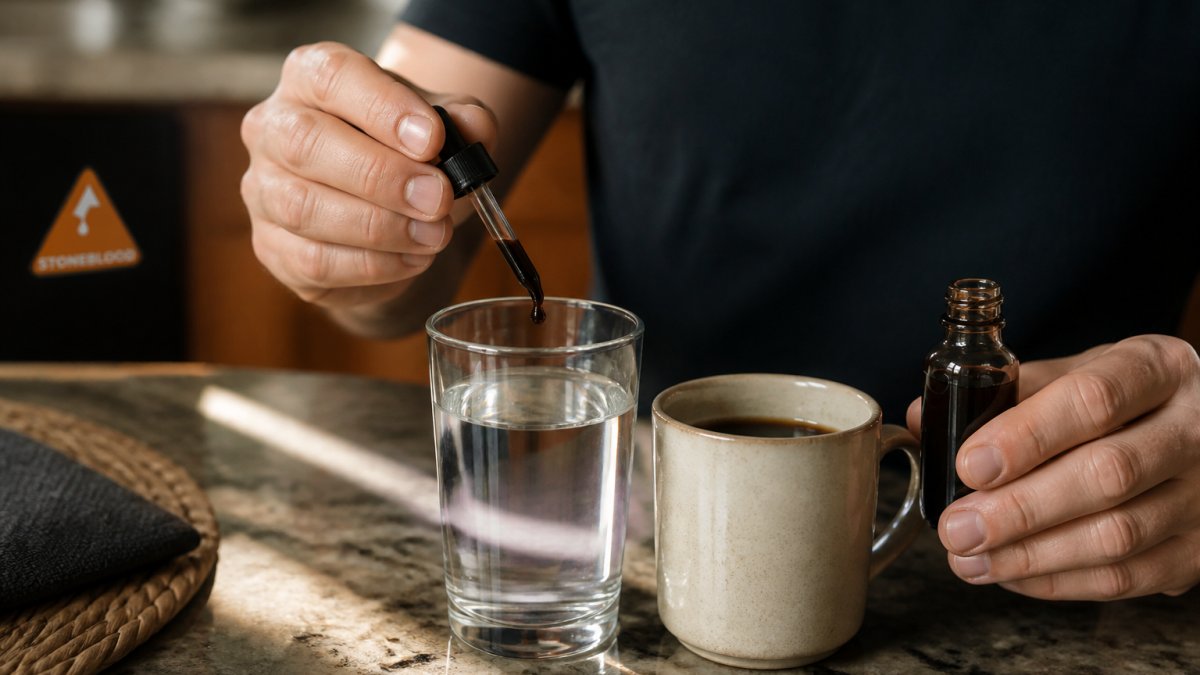
Coffee and tea both work well. The roasted or bitter notes of either drink tend to mask the mineral edge, which makes them a good choice if you do not enjoy the taste on its own.
A few practical notes from experience:
- Add drops after brewing, not during, so the heat does not sit on the extract.
- Stir for a few seconds; the liquid dissolves quickly.
- Start with a full glass of liquid if the flavor is new to you.
If you want the taste to disappear almost entirely, a smoothie or a glass of juice does the job better than water.
Shilajit Resin Preparation: What the Traditional Format Requires
Resin preparation is a small ritual, and that is either its charm or its downfall depending on your morning. There is no dropper and no measuring line.
A typical approach looks like this: soften a small portion of resin, measure out roughly a pea-sized amount, dissolve it in warm water or milk, and stir until it fully breaks down.
Shilajit Liquid Drops, Double Strength – Stoneblood Magic Brown, 1 fl oz →
The measurements are also approximate. Resin is measured by eye and by feel, which means serving size drifts from day to day.
Portability, Travel, and Real-World Use Scenarios
Travel is where the two formats separate most clearly. A sealed dropper bottle survives a weekend bag, a gym locker, and a hotel bathroom counter without incident.
Resin is workable on the road, but it asks more of you. It can soften in a hot car, stick to its container, and require warm water you may not have.
Consider three real scenarios:
- The 6 a.m. commuter: drops into a travel mug, done in ten seconds.
- The weekend hiker: a dropper bottle in a pack, no heat or stirring required.
- The slow-morning ritualist: resin, warm water, and a few unhurried minutes.
None of these people are wrong. They simply need different formats.
Reading Labels and Choosing a Format You Trust
Label transparency should decide more of this purchase than format does. A convenient product you cannot verify is not actually convenient, it is just easy to open.
Here is a neutral checklist that works for any format, liquid or solid:
- What is the product, stated plainly? A liquid extract should say so. Vague terms like "shilajit blend" or "proprietary complex" tell you nothing about what is in the bottle.
- What is the serving size, and how many servings are in the container? This is the number that lets you compare across formats. A dropper, a pinch, and a scoop are not equivalent units until you know what each one is supposed to deliver.
- Is the raw material sourced and identified? Origin matters for a substance pulled from rock. A named region or source is more useful than a generic claim.
- Is there a stated extraction or processing method? Water-based extraction is common; whatever the method, naming it is a sign the maker expects scrutiny.
On that last point, our own batches are bottled in a cGMP-certified facility and tested by an accredited lab, and the specifics live on our quality and safety page rather than in this article.
Comparing Servings Without Guessing
This is where most format comparisons fall apart. A resin portion is typically described by size, a pea-sized amount, a small pinch, while a liquid is described by dropper.
The honest way to compare is to work from the label, not from the format:
- Find the labeled serving size for each product.
- Find the labeled amount of extract or active material per serving, if the maker discloses it.
- Compare those two numbers, not the physical volume of the dose.
If a product does not disclose its extract content per serving, you cannot make the comparison, and that absence is itself information about the label. A maker who expects you to compare will give you the numbers to do it.
Matching Format to How You Actually Live
Once the labels are comparable, the format decision gets simpler. A few patterns hold up:
- If your mornings are rushed, a liquid that dissolves in seconds removes the most friction.
- If you travel often, a sealed dropper bottle handles a bag, a locker, and a hotel counter without the softening and stickiness that a solid format can develop in heat.
- If you dislike sticky textures or measuring by eye, a dropper gives you a repeatable unit instead of an approximation.
- If you value a slower, hands-on ritual, a traditional solid format may suit you better, and that is a legitimate reason to choose it.
None of these are wrong answers. They are different answers to the same question: which format will you still be using in three months?
If you want the fastest daily format, our double-strength Magic Brown liquid shilajit drops are built around exactly that. If you prefer a gentler starting point, Shilajit Original uses the same liquid format, and the Shilajit Original 3-Bottle Pack is the option for people who already know they will keep going.

For a broader look at how regulators treat supplement labeling and claims, the FDA's guidance on dietary supplement labeling is worth reading before you buy from any brand.
Frequently Asked Questions
Which form of shilajit is easiest to use in a daily routine?
Liquid shilajit drops are generally the simplest to work into a routine because there is nothing to break apart or soften. You squeeze one dropper into water, coffee, tea, or food, or take it under the tongue. Resin, by contrast, is sticky and needs to be warmed and dissolved before it mixes. For most people juggling a morning schedule, drops remove the extra step that causes them to skip days.
Do liquid shilajit drops need to be dissolved before use?
No. Liquid shilajit drops are already refined into a water-soluble form, so they disperse the moment they hit liquid. That is the main practical difference from raw resin, which is thick and tacky and typically needs to be warmed between your fingers or stirred into hot water before it will blend. With drops, you can add them straight to a glass of water or a mug of tea and drink.
Can liquid shilajit drops be added to water, coffee, or tea?
Yes. The label directions for Stoneblood liquid shilajit say to take one dropper (about 10 to 15 drops) daily in water, coffee, tea, or food, or under the tongue. The drops mix cleanly into any drink, which makes them easy to fold into a habit you already have, like a morning cup of coffee. Resin can also go into warm drinks, but it usually needs stirring and may leave a sticky residue.
What should I look for when choosing liquid shilajit or resin?
Start with the label and the sourcing story. Look for a product that states where the shilajit was wildcrafted, how it was refined, and whether the batch was third-party tested. Stoneblood's liquid shilajit drops are wildcrafted in Utah, refined in distilled Rocky Mountain spring water, and bottled from a cGMP-certified, third-party-tested batch. If a brand cannot tell you where its raw material came from or who tested it, that is a reason to keep looking.