
Shilajit Interactions With Common Medications

Table of Contents
- What Shilajit Interactions With Common Medications Actually Involve
- Prescribed Medication Categories Worth a Conversation
- Timing and Staggering Doses: A Practical Approach
- Over-the-Counter Supplements and Shilajit Interactions
- How to Talk to Your Doctor About Supplements
- Identifying Pure Shilajit Resin vs Liquid Drops
- Frequently Asked Questions
Last Updated: September 27, 2026
What Shilajit Interactions With Common Medications Actually Involve
Shilajit interactions with common medications are the ways a mineral-rich supplement may change how a prescription behaves in the body, either by affecting absorption or by adding to its effect. At Stoneblood Shilajit, we answer this question often: shilajit is not a drug, but it is also not inert. It carries fulvic acid and trace minerals, and that combination can matter when you take prescription medication daily.
Prescribed Medication Categories Worth a Conversation
Prescription categories matter most when a supplement affects absorption, metabolism, or the way the body clears a drug. Shilajit is taken orally, so it moves through the same digestive path as most medications. Most supplement-drug interactions fall into one of three mechanisms:
- Mineral chelation in the gut. Shilajit carries trace minerals and fulvic acid. Minerals can bind to certain drugs in the digestive tract and form a complex that neither absorbs well. This is the same reason calcium and iron are separated from thyroid medication by several hours.
- Competition for absorption transporters. The gut uses specific protein channels to pull compounds across the intestinal wall. When two substances arrive at the same channel at once, one can crowd out the other. This is a timing problem more than a chemistry problem, which is why staggering doses helps.
- Liver enzyme competition (CYP450). The cytochrome P450 family of enzymes in the liver breaks down most prescription drugs. Some botanical and mineral supplements can nudge the activity of specific CYP enzymes up or down, so a drug may clear faster or slower than expected. Fulvic acid is the shilajit component most often discussed here, though human data is limited.
Blood Thinners and Anticoagulants
Anticoagulant medications, including aspirin and prescription blood thinners, are the category where caution runs highest. These drugs have a narrow window between an effective dose and a risky one, and anything that shifts absorption or adds to the effect can matter.
Hormone-Modulating Drugs and Thyroid Function Medications
Hormone-modulating drugs and thyroid medications such as thyroxine are sensitive to how and when they are absorbed. Thyroid medication is usually taken on an empty stomach for a reason: food, minerals, and other supplements can interfere with uptake through the chelation mechanism described above. A practical rule is to separate shilajit from thyroid medication by several hours, and to confirm that separation with your prescriber or pharmacist first.
Lithium and Medications With a Narrow Therapeutic Index
Lithium is the clearest example of a drug with a narrow therapeutic index, meaning small changes in serum levels can shift it from helpful to harmful. Medications in this group require regular monitoring and careful dosage titration.
Other Categories Worth Naming at Your Appointment
Beyond the three above, a few more categories come up often enough to name when you talk to your prescriber:
- Medications absorbed on an empty stomach, because any oral supplement taken nearby can change the absorption window
- Extended-release and delayed-release formulations, because these depend on a precise dissolution timeline in the gut
- Drugs with a documented food or mineral interaction on the label, since shilajit is mineral-bearing
- Anything you take once daily and cannot easily re-time, which makes the conversation more important, not less
Timing and Staggering Doses: A Practical Approach
Timing is the single most useful lever you control. Staggering doses means separating your supplement from your medication by a set number of hours so the two are less likely to compete for absorption in the gut. A common approach is a two-to-four hour gap, but the exact window depends on the drug. Ask your pharmacist, who can check the specific interaction profile of what you take.
How to Build a Personal Timing Plan
A timing plan is not a single rule. It is a short sequence you build once and then follow:
- List every medication with its label instructions. Write down the drug name, the dose, and any instruction like "take on an empty stomach" or "take with food." Those instructions are the fixed points your plan works around.
- Mark the drugs that cannot move. Some medications must be taken at a specific time or with a specific meal. Those are anchors. Everything else flexes around them.
- Place shilajit in the largest open window. If your anchor drug is taken first thing in the morning on an empty stomach, the easiest slot for shilajit is often mid-afternoon or with an evening meal.
- Confirm the gap with your pharmacist. Tell them the drug name and the window you are considering. They can say whether two hours is enough or whether that drug needs four or more.
- Write the plan down and date it. Keep it with your medication list.
What to Do When a Drug Cannot Be Moved
Some medications have to be taken at a fixed time, with a fixed meal, or on an empty stomach with nothing else nearby. When that is the case, the shilajit dose moves, not the medication. A few patterns that tend to work:
- Morning anchor drug, empty stomach: take shilajit with an afternoon or evening meal instead
- Twice-daily medication: place shilajit in the middle of the longest gap between doses
- Medication taken with food: take shilajit with a different meal
- Medication taken at bedtime: take shilajit in the morning, well before the evening dose
| Medication Category | Timing Approach | Why It Helps |
|---|---|---|
| Thyroid medication | Take on empty stomach, separate supplement by 4 hours | Reduces mineral chelation in the gut |
| Anticoagulants | Confirm timing with prescriber first | Supports consistent serum levels |
| Narrow therapeutic index drugs | Follow monitoring schedule, log supplement use | Keeps dosage titration accurate |
| Extended-release formulations | Separate by at least 2 hours, confirm with pharmacist | Protects the dissolution timeline |
| General prescriptions | Two-hour gap as a starting point | Lowers chance of absorption overlap |
Logging What You Actually Do
A timing plan only works if you can tell your prescriber what you did. A simple log with four columns is enough:
- Date
- Medication name and dose, with time taken
- Shilajit time taken
- Any change you noticed, in plain language
Over-the-Counter Supplements and Shilajit Interactions
Over-the-counter supplements are easy to overlook because nobody prescribes them. That is a mistake. Many common supplements carry their own interaction potential, and stacking them with shilajit multiplies the variables rather than adding one.
Watch for these when you already take shilajit:
- Mineral supplements such as iron, calcium, or zinc, which compete for the same absorption pathways
- Herbal blends marketed for energy, which may contain stimulants that overlap with how you feel on shilajit
- Multivitamins taken at the same time as a prescription, which can affect uptake independently
- Any supplement labeled "proprietary blend", because the amounts are not disclosed
How to Talk to Your Doctor About Supplements
Talking to your doctor about supplements works best when you bring specifics, not a general question. Vague mentions get vague answers. A short, structured conversation gets you a real recommendation.
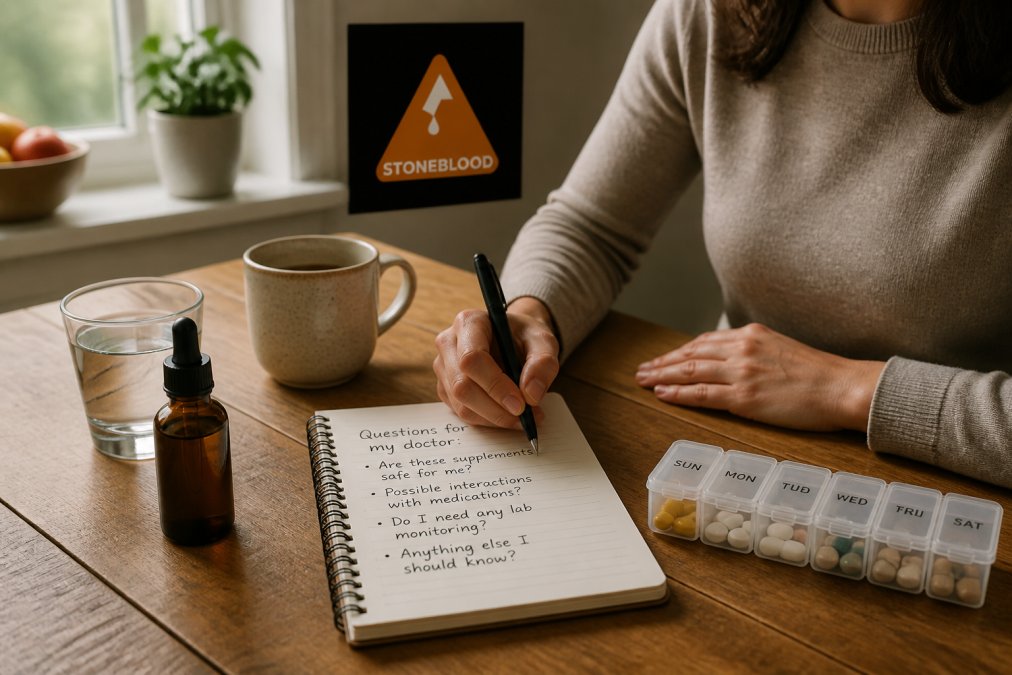
Use this checklist at your next appointment:
- List every prescription, including dose and timing
- List every over-the-counter supplement, vitamin, and herbal product
- Name the specific shilajit product and how much you take daily
- Ask directly: "Does this interact with anything I take?"
- Ask about timing: "Should I separate this from any of my doses?"
- Ask whether any monitoring needs to change
- Write down the answer and the date
Identifying Pure Shilajit Resin vs Liquid Drops
Knowing what you are actually taking is the foundation of any interaction conversation. Raw shilajit is a resin in nature, sticky and mineral-dense, and it has been used that way for centuries. A water-soluble liquid shilajit, like the drops we make at Stoneblood Shilajit, mixes evenly, so each dropper delivers a consistent amount, consistency that makes a timing plan possible in the first place.
- Sourcing transparency: a named origin, not a vague regional claim
- Third-party testing: results you can request, not just a badge on the label
- Plain ingredient list: no fillers, additives, or undisclosed blends
- Consistent form: liquid drops measure the same every time; raw resin does not
Frequently Asked Questions
What should I avoid while taking shilajit?
The main thing to avoid is taking shilajit at the same time as prescription medications without checking with your doctor first. Shilajit is a mineral-rich phytocomplex, and minerals can bind to certain drugs in the gut, which may affect how much of the medication your body absorbs. If you take blood thinners, thyroid medication, lithium, or any drug with a narrow therapeutic index, talk to your prescriber before adding shilajit drops to your routine.
Can I take shilajit and magnesium together?
Many people do take shilajit alongside magnesium, since both are mineral-based. The practical concern is timing rather than the combination itself. If you take magnesium or other mineral supplements, separating them from your prescribed medications by a few hours is a reasonable habit. Your pharmacist can confirm whether any spacing is needed for your specific prescriptions, and they can also flag any contraindications based on your full medication list.
How do I discuss supplement use with my healthcare provider?
Bring the actual bottle or a photo of the label to your appointment. Tell your provider the product name, that it is a liquid shilajit drop, and how you take it, following the label directions of one dropper daily. Mention every prescription and over-the-counter product you use. Ask directly whether any drug-nutrient interaction applies to your medications. A pharmacist is often the fastest resource for checking interactions, and they can review your full list in minutes.
Why does shilajit quality matter for interactions?
Quality affects what is actually in the bottle. A poorly refined product may carry contaminants or unknown additives that add risk on top of any drug-nutrient interaction. Stoneblood shilajit is wildcrafted in the Rocky Mountains, refined in Utah, and bottled in a cGMP-certified facility with third-party testing on every batch. You can review testing details at our quality and safety page. Whatever brand you choose, read the label and confirm the fulvic acid and mineral content is disclosed.