
Last Updated: October 22, 2026
Quick Summary
A fulvic acid mineral is a mineral bound to fulvic acid, a water-soluble organic acid formed as plant matter and microorganisms break down in soil. Fulvic acid acts as a carrier that holds trace minerals in a soluble form through chelation. It is not itself a mineral, and its mineral profile depends on the source it came from.
- Fulvic acid is the smaller, water-soluble fraction of humic substances and dissolves in water at any pH.
- Fulvic acid binds minerals through chelation at its carboxyl and phenolic groups, forming a stable, reversible ring-like structure.
- The mineral profile of any fulvic acid product is a fingerprint of its source and how it was processed.
- Human clinical research on fulvic acid and mineral absorption is limited, and those studies did not use Stoneblood products.
- Stoneblood Shilajit is bottled in a cGMP-certified facility, third-party tested, and lot-coded for batch traceability.
Table of Contents
- Fulvic Acid Mineral Basics: What It Actually Is
- The Fulvic Acid Chemical Composition, Explained Simply
- Where Fulvic Acid Comes From: Humus, Soil, and Water
- Fulvic Acid Mineral Content and Mineral Binding
- Fulvic Acid in Shilajit: How the Two Connect
- Mineral Absorption: What Is Known and What Is Claimed
- Shilajit Quality and Purity: How to Judge a Bottle
- Conclusion
- Frequently Asked Questions
Fulvic Acid Mineral Basics: What It Actually Is
A fulvic acid mineral is a mineral bound to fulvic acid, an organic acid that forms as plant matter and microorganisms break down in soil. Fulvic acid is a natural compound that acts as a carrier, holding trace minerals in a water-soluble form.
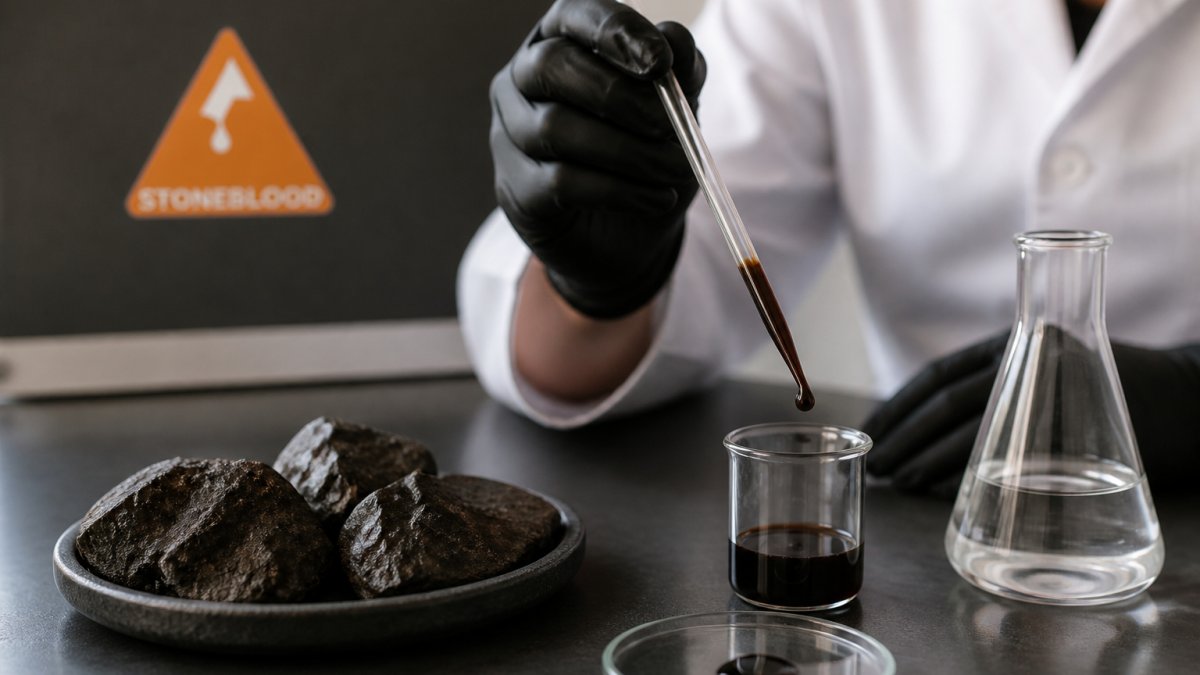
Here at Stoneblood Shilajit, we work with wildcrafted North American shilajit refined into water-soluble liquid drops, and fulvic acid is the component that carries its mineral content.
Fulvic Acid vs. Humic Acid vs. Minerals
The three terms get used interchangeably, and that is the first mistake most guides make. They are not the same substance.
- Fulvic acid is the smaller, water-soluble fraction of humic substances. It dissolves in water at any pH, which is why it can move through soil and into water.
- Humic acid is the larger fraction. It does not dissolve in acidic water and stays behind in the soil.
- Minerals are the elemental nutrients, such as iron, zinc, magnesium, and potassium, that fulvic acid can bind to.
Humic substances as a group are the dark, complex organic matter left after decomposition. Fulvic acid is one part of that group. A mineral is a separate category entirely.
The Fulvic Acid Chemical Composition, Explained Simply
Fulvic acid's molecular structure is built around carboxyl groups, which are the parts of the molecule that bind minerals and give the compound its acidic character. It also contains phenolic groups and other organic acid units.
That is the short version. The practical takeaway is that fulvic acid's chemical composition is what makes mineral binding possible. Without those carboxyl groups, the molecule would have nothing to grip.
Where Fulvic Acid Comes From: Humus, Soil, and Water
Fulvic acid comes from humus, the dark organic matter in soil, peat, compost, and sediment. It forms through the decomposition of plant matter by microorganisms over long periods.
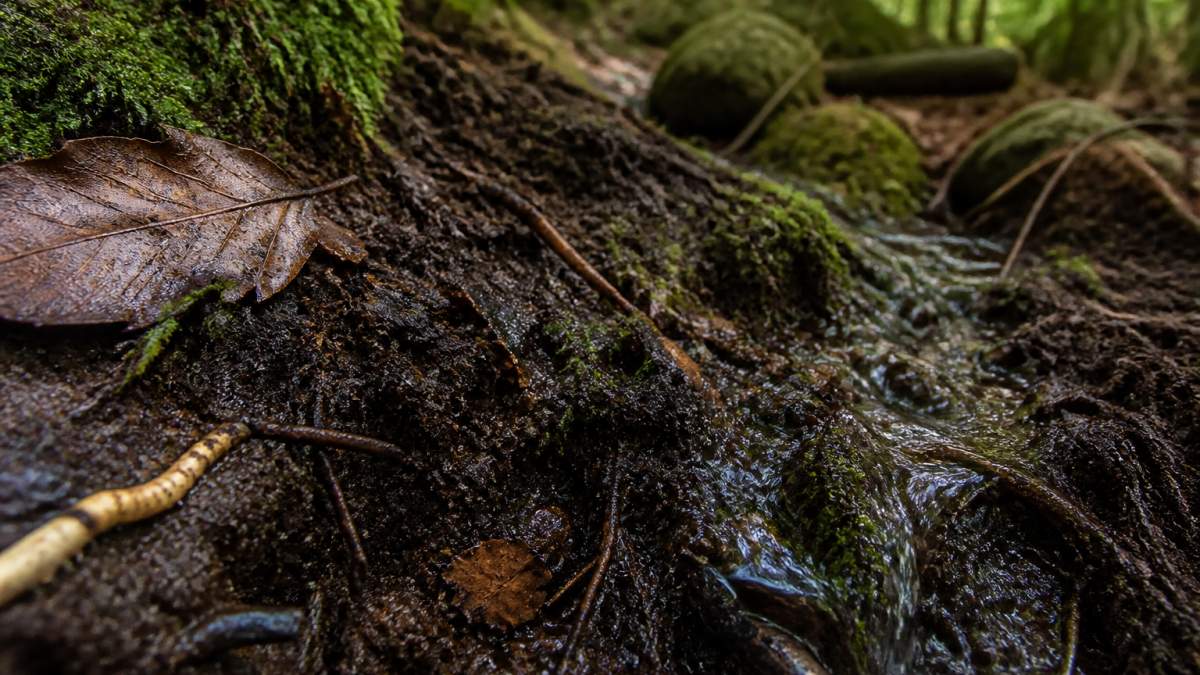
You will find it in streams, lakes, and soil solutions, often as a yellow-brown substance. Its presence in water is one reason fulvic acid is described as a natural compound rather than a manufactured one.
Fulvic Acid Mineral Content and Mineral Binding
Fulvic acid's relationship with minerals is the part that gets oversold, so let's be precise. Fulvic acid binds minerals through chelation, a process in which the organic molecule wraps around a mineral ion and holds it (pubmed.ncbi.nlm.nih.gov). This is well documented in soil science and chemistry, and it is the single most useful fact for understanding what a "fulvic acid mineral" actually is.
How Chelation Works, Step by Step
The binding happens at fulvic acid's carboxyl and phenolic groups. These groups carry a negative charge at typical soil and water pH, and many mineral ions, iron, zinc, magnesium, calcium, copper, manganese, carry a positive charge. Opposite charges attract, and the flexible fulvic acid molecule folds around the ion so that several binding groups contact it at once. The result is a stable, ring-like structure called a chelate.
Two practical consequences follow from that structure:
- The mineral stays in solution. A chelated mineral is held in a water-soluble form rather than settling out as an insoluble salt. That is why fulvic acid can move minerals through soil and into water.
- The bond is reversible. Chelation is not a permanent cage. Minerals can be exchanged or released depending on pH, concentration, and what else is present in the solution. This is one reason fulvic acid is described as a carrier rather than a container.
Bound Minerals vs. Free Minerals
A mineral in a fulvic acid complex is not the same as the same mineral in its free ionic form. In a free form, minerals can react with other compounds in the environment and become unavailable.
What fulvic acid does not do is contain minerals on its own. It carries them. The mineral content of any fulvic acid product depends entirely on the mineral source it was extracted from and how it was processed.
Why the Mineral Profile Varies by Source
Because fulvic acid binds whatever minerals are present in its environment, the mineral profile of a finished product is a fingerprint of its source.
This is why a vague label that says only "fulvic acid" tells you very little. The useful questions are where the material came from, what minerals its source naturally contains, and whether the finished product preserves the water-soluble bound form.
What Fulvic Acid Does Not Contain
Fulvic acid itself is not a vitamin, not a protein, and not a living organism. It does not contain minerals unless it has bound them from its environment. A product labeled as fulvic acid with no mineral source is simply the organic acid, not a mineral supplement.
Fulvic Acid in Shilajit: How the Two Connect
Fulvic acid in shilajit is the reason the substance is valued as a mineral source. Shilajit is a resin that seeps from rock in mountain ranges, formed from compressed plant material and humus over long periods (Shilajit: a review). It naturally contains fulvic and humic acids alongside trace minerals (Chemical Analysis of Native Himalayan Shilajit: An Evaluation of an Ayurvedic Formulation).
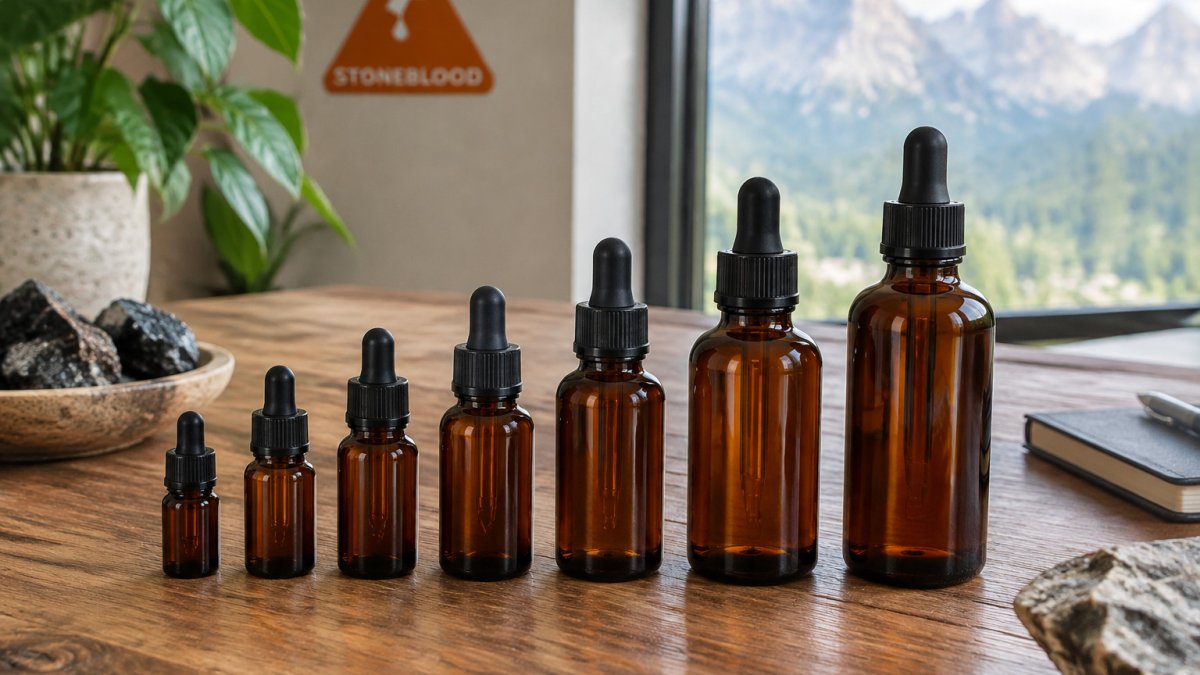
At Stoneblood Shilajit, our raw shilajit is wildcrafted in the Rocky Mountains and refined in distilled spring water into liquid shilajit drops. The refinement step makes the fulvic acid and its bound minerals water-soluble, so they mix cleanly into water, coffee, tea, or food.

Mineral Absorption: What Is Known and What Is Claimed
Here is where honesty matters most. Fulvic acid's ability to bind minerals is established chemistry. Whether that binding improves mineral absorption in the human body is a separate question, and the human clinical evidence is limited. Most guides blur those two facts together. This section separates them.
Shilajit Original — Stoneblood →
The Proposed Mechanism
The working theory is straightforward: because fulvic acid holds minerals in a soluble, chelated form, those minerals may stay available longer in the digestive tract instead of reacting with other compounds and becoming insoluble.
A chelated mineral still has to survive digestion, cross the intestinal lining, and enter circulation. How much of a fulvic-bound mineral actually completes that journey, and whether it does so better than the same mineral in another form, is what researchers are still working out.
Separating the Evidence Tiers
It helps to sort claims by the kind of evidence behind them:
- Established chemistry: Fulvic acid chelates minerals and keeps them soluble. This is well documented in soil science and chemistry.
- Laboratory and animal work: Studies in these settings suggest fulvic acid can influence how minerals behave in a biological system. These are useful signals, not proof of human outcomes.
- Human clinical research: Direct human studies on fulvic acid and mineral absorption are limited. Where they exist, they are small, and they do not use Stoneblood products. We describe results neutrally and do not claim they apply to our drops.
That hierarchy is the honest way to read any bioavailability claim you see on a label or a product page.
How to Read a Bioavailability Claim
When a product says fulvic acid "improves mineral absorption" or "delivers minerals at the cellular level," ask three questions:
- What kind of study is being cited? A test-tube result and a human trial are not the same thing.
- Which mineral, and in what form? Absorption claims are mineral-specific. A finding about one mineral does not automatically transfer to another.
- Does the claim apply to this product? A study on a different fulvic acid source, dose, or format does not establish anything about the bottle in front of you.
Many supplement makers claim fulvic acid improves mineral uptake and bioavailability. Those claims are plausible based on how fulvic acid behaves in soil and water, but they are not the same as proven human outcomes. We describe fulvic acid as traditionally used in Ayurveda and as a mineral carrier. We do not claim it treats or prevents any condition.
What We Say, and What We Don't
Our position is deliberately modest. We describe fulvic acid as a mineral carrier and note its traditional use in Ayurveda. We do not claim our drops improve mineral absorption, and we do not present laboratory findings as if they were human results. If you want to read how we handle testing and quality, see our quality and safety page.
Shilajit Quality and Purity: How to Judge a Bottle
Shilajit quality and purity come down to sourcing, testing, and traceability. Because shilajit is harvested from the ground, contamination is a real concern, and a trustworthy product should be able to answer basic questions about where it came from and how it was tested.
Use this checklist when evaluating any shilajit product:
- Is the source stated clearly, including the region and whether it was wildcrafted or imported?
- Is the product third-party tested for heavy metals and microbials?
- Is the facility cGMP-certified?
Stoneblood Shilajit is bottled in a cGMP-certified facility, third-party tested, and lot-coded so each batch is traceable.
Conclusion
Fulvic acid mineral content is real, but it is narrower than most marketing suggests. Fulvic acid is an organic acid that binds minerals; it does not create them, and its absorption benefits in humans are still being studied.
If you want a shilajit product where the fulvic acid and minerals arrive in a water-soluble liquid form, with lot-level traceability and third-party testing, our Magic Brown double-strength drops are where we would start. For current options and prices, compare Stoneblood Original and Magic Brown.

Fulvic acid is a fascinating molecule, but it is not a shortcut around good sourcing.
These statements have not been evaluated by the Food and Drug Administration. This product is not intended to diagnose, treat, cure, or prevent any disease.
Frequently Asked Questions
What is fulvic acid, and how is it related to minerals?
Fulvic acid is a naturally occurring organic acid formed when plant matter and microorganisms break down in soil, peat, and sediment. It is a small, water-soluble molecule with many carboxyl groups, and those groups bind to trace minerals. That is why the phrase fulvic acid mineral is common: the acid itself is not a mineral, but it holds minerals and keeps them in a form that can move through water. Shilajit is one natural source where fulvic acid and a broad mineral profile appear together.
Does fulvic acid itself contain minerals?
Not in a fixed way. Fulvic acid is the carrier molecule, not the cargo. Its composition varies by source, so the mineral content of any fulvic acid product depends on where the raw material came from and how it was processed. A fulvic acid mineral content claim should be backed by a batch-specific test, not a generic label figure. Ask which minerals were measured, at what levels, and whether the results apply to the lot on the shelf.
What is the chemical composition of fulvic acid?
Fulvic acid is a mix of organic molecules rather than one fixed compound. It is built mainly of carbon, hydrogen, and oxygen, with carboxyl and phenolic groups that give it a negative charge and let it bind positively charged ions. Because the exact structure shifts with source and season, chemists describe it by its functional groups and behavior, not by a single formula. This variability is why testing matters more for fulvic acid than for a simple mineral salt.
How can you assess the quality of a fulvic acid supplement?
Start with traceability. A serious product names its source, states whether the material was wildcrafted or cultivated, and provides a lot number you can match to a certificate of analysis. Look for third-party testing by an accredited lab, with heavy metals screened by a method such as ICP-MS. For shilajit quality and purity, also check that the product is bottled in a certified facility and that the seller will share results for your specific batch on request.
What should you look for when choosing a shilajit product?
Choose a product that tells you where the raw shilajit came from and how it was refined. Stoneblood, for example, wildcrafts North American shilajit and refines it into water-soluble liquid drops in Utah, with batch testing and lot codes on every bottle. You can review the testing approach at the quality and safety page. Avoid listings that give no source, no lot number, and no way to see a certificate of analysis.
Does fulvic acid occur naturally in shilajit?
Yes. Shilajit forms over long periods from compressed plant material and humus in mountain rock, and fulvic acid is one of the organic acids present in the resulting resin. That is the link between fulvic acid in shilajit and the mineral side of the substance: the acid and the minerals occur together in the same raw material. How much survives into a finished product depends on refining, which is why source and process both matter.
What not to mix with fulvic acid?
There is no single official list, and interactions depend on the product. A practical rule is to keep it simple: mix liquid shilajit drops into water, coffee, tea, or food as the label directs, and avoid combining multiple mineral or fulvic acid products on your own. If you take prescription medication or manage a health condition, ask a healthcare professional before adding any supplement, since they can review your full routine.

Share:
5 Reasons to Choose North American Sourced Supplements
How Omega-3 Fatty Acids Reduce Exercise-Induced Inflammation