

Last Updated: October 26, 2026
Quick Summary
Shilajit for daily energy support works best as a small, repeatable habit: take one dropper (about 10 to 15 drops) once a day in water, coffee, tea or food, or under the tongue. Expect little in week one and only a gradual sense of steadiness, if anything, over weeks two to four.
- Raw shilajit is a sticky resin, but Stoneblood refines wildcrafted North American resin into a water-soluble liquid.
- Rate morning steadiness, afternoon dip and evening wind-down weekly on a 1 to 5 scale for four weeks.
- A certificate of analysis only matters if its lot number matches the bottle in your hand.
- Liquid drops take seconds to measure and dissolve cleanly, while resin needs manual measuring and working in.
- If your energy hasn't shifted after a fair trial, stop and look at sleep and food first.
Table of Contents
- Why Shilajit Fits a Daily Energy Routine
- How to Take Liquid Shilajit Step by Step
- Liquid Shilajit vs Resin: Which Form Fits Your Day
- Shilajit in Coffee: A Simple Morning Pairing
- Shilajit Quality and Sourcing: What to Check Before You Buy
- Fulvic Acid, Minerals and Everyday Vitality
- Tracking Your Energy and Adjusting the Routine
- Start Your Morning Routine with Stoneblood Liquid Shilajit
- Frequently Asked Questions
Why Shilajit Fits a Daily Energy Routine
Shilajit for daily energy support can be part of a small, repeatable habit. At Stoneblood Shilajit, we describe it plainly: shilajit is a mineral-rich substance that seeps from rock in mountain ranges, formed over a very long time from compressed plant material and humus. In Ayurveda it is classed as a Rasayana, a traditional category of rejuvenating preparations (An Overview on Ashwagandha: A Rasayana (Rejuvenator) of Ayurveda).
That history matters more than any slogan.
What Shilajit Is and How It Is Traditionally Used
Raw shilajit is a sticky, tar-like resin that oozes from rock. Our own product takes that path further: we refine wildcrafted North American resin in distilled Rocky Mountain spring water until it becomes a fully water-soluble liquid. The word resin on a label describes the raw material, not necessarily what's in the bottle.
Setting Realistic Expectations for Energy
Most guides promise a transformation. We would rather you expect something quieter.
- Week one: little to report for most people
- Weeks two to four: a gradual sense of steadiness, if anything
- Beyond that: the honest answer is that responses vary, and some people notice nothing at all
Shilajit is a dietary supplement.
How to Take Liquid Shilajit Step by Step
The label directions are simple.
- Check the label. One dropper, about 10 to 15 drops, once a day.
- Pick your carrier. Water, coffee, tea, or food all work. The drops mix cleanly.
- Or go under the tongue. Some people prefer it straight, especially once they acquire the taste.
For the fuller version, our guide on how to take StoneBlood walks through the practical details.
Building the Habit: Morning, Coffee or Under the Tongue
Coffee and under-the-tongue use are options for taking the drops.
Liquid Shilajit vs Resin: Which Form Fits Your Day
Raw shilajit is a traditional resin; Stoneblood's product is refined into a water-soluble liquid.
| Feature | Liquid Drops | Resin |
|---|---|---|
| Measuring | One dropper | Manual, by eye |
| Mixing into drinks | Dissolves cleanly | Needs working in |
| Taste control | Easy to dilute | Strong, harder to mask |
| Portability | Sealed bottle | Sticky container |
| Daily effort | Seconds | A minute or more |
For the longer comparison, read liquid shilajit drops vs resin.
Best for: anyone who wants the routine to take seconds. Skip if: you specifically want the raw traditional material and don't mind the prep.
Shilajit in Coffee: A Simple Morning Pairing
The earthy flavor of the drops can be paired with coffee.
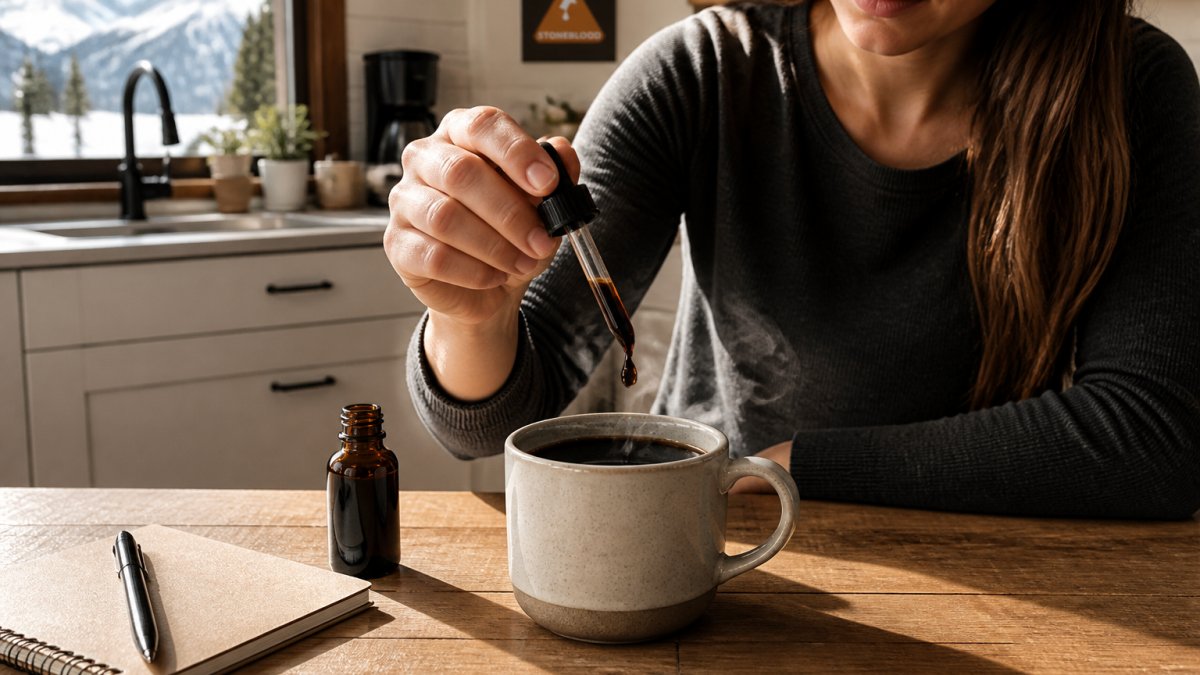
The label directions allow taking the drops in tea or water.
Shilajit Quality and Sourcing: What to Check Before You Buy
When considering shilajit, ask what sourcing and testing information a seller can provide.
Why Contamination Is a Real Concern
Stoneblood's Magic Brown liquid shilajit is third-party tested for heavy metals and microbials. See our quality and safety page for more information.
What a Certificate of Analysis Should Cover
A certificate of analysis, or CoA, is the document a laboratory issues after testing a sample. It is only meaningful if tied to a specific lot number, because a CoA from last year's material says nothing about the bottle in your hand. Look for these panels:
- Heavy metals: lead, arsenic, cadmium, and mercury are the standard four. The result should be reported as a measured number, not just a pass or fail.
- Microbiology: total plate count, yeast and mold, and screening for common pathogens. This is the panel that catches poorly dried or poorly stored material.
- Identity and composition: some labs confirm the material is what it claims to be and report fulvic acid content. This matters because shilajit is sometimes cut with other substances.
- The lot number itself: it should match the number printed on your bottle. If it does not, the document is decoration.
You do not need to interpret every number yourself, just confirm the panels exist, are recent, and correspond to your batch. A seller who publishes a sample CoA but cannot supply one for your lot is showing you marketing, not testing.
Questions Worth Asking Before You Buy
- Does the seller name where the material was harvested, not just the country?
- Is there a named testing laboratory, not just the phrase 'third-party tested'?
- Can you request a certificate of analysis for your specific lot number?
- Does the CoA include heavy metals and microbiology panels with measured results?
- Is the bottling facility identified, and is it a cGMP facility?
- Does the label give clear directions and a best-by date?
Anything vague on those points deserves skepticism. A seller who answers all six promptly is usually a seller worth staying with.
For a step-by-step version of this checklist, see how to identify high quality shilajit. We also publish our own testing and safety information on our quality and safety page rather than repeating numbers here.
Shilajit Original — Stoneblood →
Fulvic Acid, Minerals and Everyday Vitality
Fulvic acid is a component of shilajit. It helps to understand what it is first.
What Fulvic Acid Is
Fulvic acid is a family of organic compounds associated with humic substances (Biomedical Applications of Humic Substances).
Stoneblood refines shilajit in water into a water-soluble liquid.
How Fulvic Acid and Minerals Fit Together
Stoneblood's Magic Brown liquid shilajit listing describes fulvic and humic acids and 85+ minerals.
What This Means for a Daily Routine
The label directions are 1 dropper (about 10 to 15 drops) daily in water, coffee, tea, or food, or under the tongue.
A few practical notes:
- Water, coffee, tea, or food are listed options for taking the drops.
- Under the tongue is also an option.
For more information, see our journal piece on fulvic acid and mineral balance.
Tracking Your Energy and Adjusting the Routine
Most people never evaluate whether a supplement is doing anything. They take it, feel roughly the same, and either quit or keep buying out of habit. A short written log fixes that.
Rate three things once a week, on a simple 1 to 5 scale:
- Morning steadiness: how you feel in the first hour after waking
- Afternoon dip: how sharp you are between lunch and late afternoon
- Evening wind-down: whether you're wired or settled at bedtime
Do that for four weeks before drawing any conclusion. A common mistake is judging after three days, when nothing has had time to change. Another is changing three things at once, then having no idea which one mattered.
If your energy hasn't shifted after a fair trial, that's useful information. Stop, save the money, and look at sleep and food first. Persistent tiredness that doesn't respond to rest is worth raising with a healthcare professional rather than solving with supplements.
Start Your Morning Routine with Stoneblood Liquid Shilajit
Stoneblood offers liquid shilajit drops.
Magic Brown is our double-strength liquid shilajit, wildcrafted in North America and refined into water-soluble drops. Every batch is bottled in a cGMP-certified facility and third-party tested.

For current options and prices, compare Stoneblood Original and Magic Brown.

Explore Stoneblood Shilajit liquid drops.
These statements have not been evaluated by the Food and Drug Administration. This product is not intended to diagnose, treat, cure, or prevent any disease. Consult a healthcare professional before starting any supplement, especially if you are pregnant, nursing, taking medication or managing a health condition.
Frequently Asked Questions
Is shilajit an energy booster?
In Ayurveda, shilajit is considered a Rasayana, a traditional category of rejuvenating preparations. Stoneblood's Magic Brown liquid shilajit listing describes fulvic and humic acids and 85+ minerals.
Can shilajit be added to water, coffee, tea, or food?
Yes. The label directions for Stoneblood are 1 dropper (about 10 to 15 drops) daily in water, coffee, tea, or food, or under the tongue.
How do liquid shilajit drops compare with raw shilajit resin?
Raw shilajit oozes from rock as a thick, tar-like resin. Stoneblood refines wildcrafted North American shilajit into water-soluble liquid drops in Utah.
What should I look for when choosing shilajit?
You can read more on Stoneblood's quality and safety page before buying.


Share:
How to Combine Shilajit with Morning Coffee
The Ayurvedic Tradition of Shilajit Use: A Complete Guide